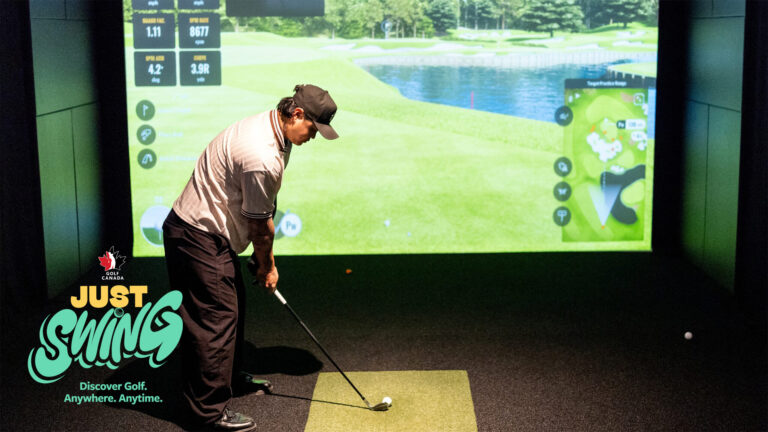


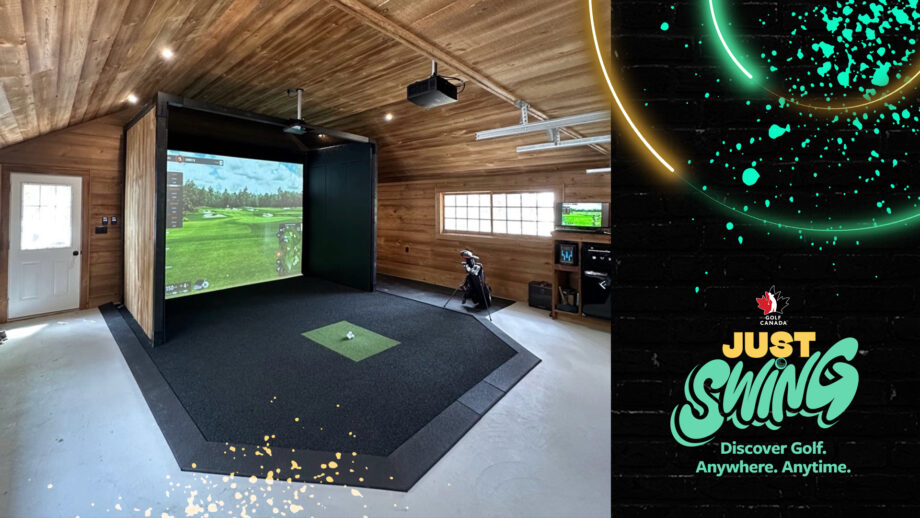
So, you want to install your own simulator at home…aside from convincing your spouse it’s the right idea there are many things to consider when adding your own slice of paradise at home.
As the outdoor season across the country comes to its annual end, golf enthusiasts are extending their season like never before.
Simulator venues, entertainment centres, practice hubs and virtual leagues are redefining how Canadians discover and stay connected to the game 12 months a year. Off-course golf is helping to increase year-round participation while attracting new players to the sport with 7.8 million Canadians engaging in off-course and alternate forms of golf. That represents a 40 per cent increase in the number of golfers using simulators and participating in off-course golf over the past five years.
Golf Canada recently sat down with Brandon Hill, owner of Hiller Golf to discuss the boom simulator and off-course golf has seen across the country and what you need to consider when adding your own personal simulator at home or the office.
Golf Canada: Thanks for joining us, Brandon, tell us about how you got your start in golf and what ultimately drew you into simulators and synthetic turf?
Brandon Hill: I got my start when ClubLink opened Glencairn Golf Club in Milton, Ont. I went on to work at St. George’s Golf and Country Club in Toronto and Quail Valley Golf Club in Vero Beach, Fla.
I’ve been a member of the PGA of Canada for close to 20 years. Working at private clubs across North America and spending time coaching and teaching showed me what different golfers enjoy about the game and what keeps them coming back.
We’ve worked with hundreds of local charities through our golf events business. Golf travel and custom experiences are also a big part of what we do. I got into simulators and synthetic turf through relationships I’d built in the golf industry. Today, designing and building custom simulators is the main part of our business, and many of those client relationships continue long after installation.
I’ve always been about the experience. The golf professional in me thinks about how people will practise and play. My landscaping and construction background helps me make every square foot work for them. That might mean designing one studio for full shots, putting, and short chips.
GC: In your opinion and experience, what’s driving the surge in off-course facilities across Canada?
BH: Convenience is the biggest reason I see. You can book a bay for an hour, play after work, or meet friends for a round in the middle of winter. A single bay can host a lesson in the morning, a practice session in the afternoon, and a league or corporate event in the evening. That flexibility gives golfers more ways to play and facility owners more ways to use the space.
GC: What’s driving people to build private simulators at home or at work?
BH: At home, you can hit balls for 20 minutes in the morning or after dinner or play a round with your kids on the weekend. We often design these rooms around the whole family, with space for golf, games, and movie nights.
At work, the appeal is often social. A simulator gives staff and clients something to do together, even if they have very different levels of golf experience. Every client uses the room differently. We design around what they’ll actually do in it, whether that’s serious practice, entertaining, or a bit of both.
GC: When did home simulators really start to take off?
BH: 2020 and the years immediately following as the turning point. People were spending more time at home and rethinking how they used their basements and garages. Improvements in technology helped make the home golf experience more realistic. As more people tried a simulator at an indoor facility, golf club or a friend’s house, it became easier to picture having one themselves.
GC: What’s one of the main reasons people contact you about a home simulator?
BH: One of the first things I hear is, “I want to keep working on my game through the winter.” That’s a big reason in Canada.
Once we start designing the room, clients often picture other ways they’ll use it, like playing with their kids, having friends over, or getting in a few swings during a busy week. Training and advanced camera work has come a long way. Even introducing weight transfer mats. Essentially an AI Coach.
GC: What should someone consider before installing a simulator, and what space and budget should they plan for?
BH: Start with the people who will use it. Can the tallest golfer swing a driver comfortably? Will both right- and left-handed players use the room?
Look at the usable space. Beams, ducts, lights, entry stairs and garage door tracks can affect the swing area. We also plan where people will sit or stand, how we’ll contain errant shots, and how much sound will carry into the rest of the home or office.
For a comfortable custom build, my planning target is 10 feet of clear height, 15 feet of width, and 20 to 25 feet of depth. Smaller rooms can work depending on the golfer, the hitting position, and the launch monitor. I like to assess the room before equipment is ordered.
Under pinning is coming more popular. digging down in the basement to create more height.
An entry-level home package can start around $15,000 to $20,000 CAD. A professionally installed custom studio build typically runs $20,000 to $30,000 CAD, with a separate technology budget of $5,000 to $45,000 CAD.
The launch monitor, projector, computer, touchscreen, and TVs affect the technology budget. The impact screen, protective panelling, and turf floor assembly help determine the cost of the studio build. All in costs can range from $15,000 to $75,000 CAD with budgets for all kinds.
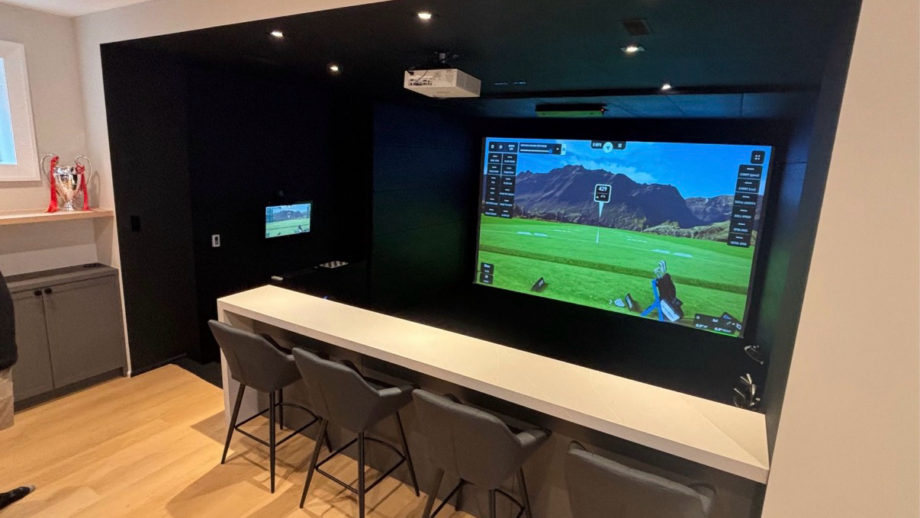
GC: It seems that interest in home putting greens is on the rise as well?
BH: Yes. A basement, gym, or backyard can be a great place for a putting green, especially when there isn’t room for a full swing indoors.
We start by asking how the client wants to use it. A green for daily putting practice might need a different layout from one designed for family and friends. Many clients want both.
GC: Do you feel the shorter time commitment with off-course golf is a benefit for golfers?
BH: Absolutely. You spend less time walking between shots or looking for balls. In an hour, you can play 18 holes or get through a focused practice session. That makes it easier for busy parents and anyone looking to fit in some golf after work.
GC: Golf has become a 12-month sport in Canada, in your opinion how much has simulator golf helped in that regard?
BH: It’s changed what winter looks like for Canadian golfers. You can stay in a league, keep taking lessons, or track a swing change through the off-season.
As a golf professional, I like what that means for the spring. If you’ve been practising consistently, your first round back can feel like picking up where you left off.
GC: From a builder’s perspective, what makes simulator golf enticing?
BH: I like designing a room where one person can dial in their wedge distances, another can play a famous course with friends, and a kid can see how far they can hit it and get instant gratification.
We design around the people using the room, how they want to play, and what will make them want to use it again. Outdoor structures are also becoming a very popular option if you don’t have room in your home.
GC: How impactful is indoor golf for introducing people to the game?
BH: It’s one of the easiest ways to give golf a try. You can go with friends, borrow a club, and hit a few balls at your own pace. There’s no group waiting behind you, and you can take another swing right away.
A few good shots can be enough to make someone want to come back. Once they’ve had that experience indoors, saying yes to the driving range or a first nine holes can feel a lot easier. I’ve seen junior golf really benefiting from indoor golf. Technology is a large part of their life and helps to introduce them to this CRAZY game.
To learn more about off-course golf or to find a Golf Canada member facility closest to you, please visit justswing.golfcanada.ca.