


Golf Manitoba announces the retirement of Garth Goodbrandson

WINNIPEG – After 23 years with Golf Manitoba, Garth Goodbrandson will retire as the Director of Player Development at the end of 2020.
Goodbrandson first began his career with Golf Manitoba in 1997 after 16 years as a PGA of Canada club professional. The move into coaching and leadership as the Director of Player Development for Golf Manitoba made him the first full time coach hired by any provincial golf association.
During his tenure with Golf Manitoba, Garth introduced thousands of young people to the sport of golf through golf in schools and rural instruction programs. In addition to grassroots programming, Garth became one of the top high-performance golf coaches in the country with many of his athletes achieving success at the junior, collegiate, amateur, and professional levels.

Photo: Bison Sports
In 1999, Goodbrandson, along with co-founder Derek Ingram, had a vision to expand high-performance golf opportunities by establishing the University of Manitoba golf program. Since the program’s inception, Goodbrandson has coached every Bison team until his retirement in the fall of 2019. During his 20-year career with the Bisons, Goodbrandson’s teams amassed over 30 wins with the most notable coming in 2014 when the men’s team won the Canadian University & College Championship. In recognition for winning the national championship, Goodbrandson was named Canadian University Golf Coach of the Year in 2014 and received the City of Winnipeg Outstanding Achievement Award in the same year. The golf team was names as a finalist for the 2014 Manitoba Sportswriter/Sportscaster Team of the Year.

Throughout his career, Goodbrandson has been recognized by his peers and numerous golf and sports associations for his dedication and commitment to coaching.
Some notable highlights include being inducted to the Manitoba Golf Hall of Fame in 2016, awarded the PGA of Manitoba Coach of the Year in 2017, 2018 and 2019 and most recently, he was honored as the Sport Manitoba Male Coach of the Year in the spring of 2020.
“As the long-time coach of Golf Manitoba’s Development programs, Garth was a leader and pioneer in many areas. Passion, dedication and care went into every program he developed but he was also extremely successful at the provincial and national level,” said Derek Ingram, Golf Canada Men’s National Amateur and Olympic Team Coach when reflecting on his fellow professional and long-time friend.
“Garth is an expert coach and has one of the best records over a long career, consistently punching above the provinces weight class. A lot of provincial and even national programs that exist now are an offshoot of Garth’s Golf Manitoba programs that he crafted. More important than his record, Garth is of the highest character, caring, thoughtful and loved by students, coaches, professionals and industry leaders alike.”
“Garth’s contributions to golfers in Manitoba are unmatched and we are thankful to have had him on our team for the past 23 years,” Golf Manitoba President Ken Warwick said, “He will be greatly missed.”
“Golf Manitoba owes a debt of gratitude to Garth for all he has done for our association and our golf community,” Golf Manitoba Executive Director Jared Ladobruk said. “Throughout his career, Garth has shown an incredible passion for coaching and has created many wonderful opportunities for young Manitoba golfers. He is a gentleman, a consummate professional and has been a tremendous ambassador of our association and of golf over the years. We are sad to see him move on but at the same time extremely happy for him as he begins this new adventure.”
Golf Genius Software signs multi-year agreement with Golf Canada

WAYNE, Penn. – Golf Genius Software, the leading worldwide provider of tournament management solutions, announced today that Golf Canada and Canada’s Provincial Golf Associations will begin using Golf Genius Tournament Management to manage their golf competitions beginning in 2021.
Golf Genius will provide Golf Canada-branded versions of its TM Club, TM Club Premium and TM Association cloud-based services to the Canadian golf market. Golf Canada and the Provincial Golf Associations will join a number of other national golf associations and tours in using the TM Association solution, which is purpose-built to meet the specialized needs of national and regional golf associations.
Golf clubs and other golf facilities across Canada will also be able to utilize the Golf Canada versions of the TM Club at preferred rates and TM Club Premium services. Golf Genius will provide single sign-on support to club administrators through the Golf Canada Score Centre and will integrate with the World Handicap System (WHS) services provided through the Golf Canada Score Centre. Golf Genius will also provide French language versions of its TM services as part of its agreement with Golf Canada.
Mike Zisman, Co-CEO of Golf Genius Software, commented: “We have committed substantial resources to build a significant presence in the Canadian market, including our recent acquisition of two respected Canadian software providers. Our new relationship with Golf Canada will not only enable us to serve the tournament management needs of Golf Canada and the Provincial Associations, it will also help us more rapidly expand our customer base in the club and facility market. We are honored to have been selected by Golf Canada for this critical relationship.”
Adam Helmer, Senior Director of Golf Services at Golf Canada, added, “We conducted a rigorous process to select a tournament management solution which included an RFP last year and the evaluation of several prospective vendors. Golf Genius presented the most robust product, and most importantly, can meet the needs of Golf Canada, our Provincial Golf Associations and over 1,400 of our member golf facilities in Canada with one integrated solution.”
In 2020, Golf Genius has also announced national association agreements with England Golf, the Singapore Golf Association and Golf NSW serving New South Wales in Australia.
VIDEO: Discussion on the state of municipal golf in Canada

On November 4th, 2020, members of the Golf Journalists Association of Canada (GJAC), took part in an online discussion on the topic of Municipal Golf in Canada. This inaugural GJAC Virtual Summit is part of an ongoing series intended to help golf journalists across Canada stay connected, as well as to generate discussion and opportunities around important issues in the game.
Format of these events consist of a moderated question and answer period, followed by a brief opportunity for questions from attendees.
Panelists for the first summit included:
- Jeff Moore, CPGA Head Professional, Golf Operations, City of Brantford
- Ryan Logan, Director, Membership, Golf Canada
- Malcolm Bromley, Former GM, Vancouver Parks and Recreation Facilities
SCOREGolf columnist Rick Young acted as moderator.
The one-hour event was recorded and is available to watch below.
Golf community saddened by passing of former Golf Canada President Findlay Young

The Canadian golf community is saddened to learn of the passing of former Golf Canada President and Honorary Life Governor Findlay Young of Prince George, B.C., who passed away suddenly on Friday, October 9, 2020 at the age of 92.
Young was born in 1928 in Glasgow, Scotland, where he met his wife Nancy. They married in 1955 and emigrated to Canada in 1957.
He served as a director at B.C. Golf from 1961-1999 and was an honourary life director. He also served as president of the Royal Canadian Golf Association (now Golf Canada) in 1993 where he was also named an honourary life governor.
In total, Young won 53 golf competitions, including 11 Prince George Golf and Curling Club championships between 1959 and 1970. He recorded eight holes-in-one.
Among his many accomplishments off the golf course, Young was a director for the Prince George Mohawks senior hockey team for 10 years and was inducted into the Prince George Sports Hall of Fame in 1998.
For many in the golf community, Findlay was a great friend and mentor whose passion for golf and contributions to the game left a lasting impact. His mark on our organization and our sport will not soon be forgotten.
Below is a message that was shared by the Prince George Golf & Curling Club and here is a link to the bio that was included with his induction into the Prince George Sports Hall of Fame.
Always prioritizing junior golf, he successfully mentored many skilled amateurs locally, provincially, and nationally, including captaining the Pacific Northwest and Canadian Junior Teams. Findlay’s rules proficiency and diplomatic skills eventually led to the presidency of Golf Canada as the first ever elected from Northern BC.
As president he attended the World rules conference and served as Canada’s golf ambassador to the 1994 Masters and Canadian, U.S., and British Opens. A lethal wedge player and scratch golfer for many years, Findlay dominated golf in the Northern interior, holding 11 club championships at the Prince George Golf & Country Club, a record that will never be equaled.
“Fin” significantly influenced all aspects of our club’s development, and on behalf of the board, our condolences and best wishes go out to the Young family.
“scíth a ligean”
Respectfully,
Don McDermid
General Manager On Behalf of the Prince George Golf and Country Club Board of Directors
Golf Canada CEO Laurence Applebaum happy with how industry stepped up during pandemic

Although restrictions put in place to slow the spread of COVID-19 initially wreaked havoc on the golf season, Laurence Applebaum said this season showed the sport’s resilience in Canada.
The Golf Canada CEO looked back at the shortened 2020 season on Wednesday as encroaching winter weather started to wind down recreational play across the country.
“What an incredibly strange and challenging year,” said Applebaum. “Golf has been a silver lining, a bright light, call it what you may, in giving people a bit of a break from the pandemic.”
The LPGA Tour was one of the first professional sports associations to be affected by the coronavirus pandemic, forcing the women’s professional circuit to cancel its Asian swing and then many more events in North America.
Canada’s two professional tournaments – the RBC Canadian Open in June and the CP Women’s Open in September – had to be cancelled. The Mackenzie Tour, a third-tier men’s tour that plays across Canada, also had its season shelved.
Golf Canada also had to cancel all of its national championships, with many provincial bodies having to postpone or drastically alter their events.
In late March Applebaum urged recreational golfers in Canada to follow the advice of public health officials, even if that meant staying off the course.
“We were cautious and we were coming into a situation with so many unknowns,” said Applebaum. “Looking back, I’m proud of the way the entire industry came together.
“I’m proud of the way the operators in particular handled play. The golf clubs, the golf club operators and owners did an exceptional job.”
Golf, however, was able to seize the moment as COVID-19 restrictions loosened across Canada for the summer.
Record numbers of recreational rounds were registered with Golf Canada through June (1.2 million), July (1.6M), and August (1.5M), as people took advantage of being able to remain physically distant but social.
View this post on Instagram
“We’re going to look back on 2020 and say ‘amongst all challenges, amongst a lot of really difficult situations for so many people, golf was a bright light that we built from,”’ said Applebaum.
“I feel really lucky, I feel quite fortunate to be a part of that movement.”
Another bright spot has been the play of Canada’s male professional players, once the PGA Tour and Korn Ferry Tour resumed their seasons.
Five Canadians were in the top 125 in the world by the end of September, led by the solid play of Mackenzie Hughes, who was No. 48 in the world. Adam Hadwin (62), Corey Conners (72), Taylor Pendrith (118) and Nick Taylor (121), also rounded out the Canadian contingent.
Pendrith earned his world ranking by virtue of being second on the feeder circuit Korn Ferry Tour’s rankings.
On the women’s side, Brooke Henderson returned to dominant form after a seven-month break from competitive play. She moved up to fourth overall in the world rankings, making her the highest-rated Canadian player of either gender.
“It’s a moment that swells the heart of our golfer nation with pride,” said Applebaum. “It continues to amaze me how passionately the country follows our Canadian golfers.”
Applebaum also noted that Golf Canada and the Golf Canada Foundation were able to give back to the community with a COVID-19 Golf Relief Fund announced in late July.
He said on Wednesday that more than $400,000 was raised for the initiative that has two main steps. The first is that the relief fund subsidizes non-medical personal protective equipment for golf course employees, as well as sanitization, hygiene, and protective material expenses. It also subsidizes rounds of golf for front-line workers as well as juniors.
Ideas to make your course more accessible

The Invictus Games, held in Toronto in September 2017, included a golf event hosted by St. George’s Golf Club where spectators were treated to outstanding performances by the athletes. Those of us fortunate enough to attend the event could not help but imagine the opportunities of engaging more people with disabilities in golf.
“This was the most memorable and inspirational event we have been a part of,” said Jason Clarke, CCM, who was general manager at St. George’s during the Games.
“St. George’s has a long history of recognizing the contributions made by Canadian service men and women, so hosting the Invictus Games was a natural fit for us,” said Clarke. “This was the first time that golf was included as an official sport of the Invictus Games and the first time they were hosted [in] Canada. We were determined to make Canada proud and give the athletes the ‘St. George’s experience.’ It was inspiring to see so many of our members volunteering for the games, including most of the caddies.
“We had the honour of hosting two Invictus athletes who utilized the Paramobile adaptive golf cart; it is a game changer! These three-wheeled vehicles can enter and exit a sand bunker, drive on a green and even navigate over a 10-inch curb. The Paramobile cart assists the athlete to standing position. This is a sensation that these golfers never thought they would experience again. It is difficult not to get emotional witnessing this achievement.”
Making your club more welcoming and accessible
Jan Bel Jan, of Jan Bel Jan Golf Course Design, is president of the American Society of Golf Course Architects and an advocate for golfers with a disability.
“People with disabilities are people first. Each of us knows someone who has difficulty with access, due to a congenital condition or because they have lost some ability because of illness, injury or age,” said Bel Jan. “The opportunity to enjoy golf provides wonderful social, recreational and healthful experiences for everyone. A welcoming and accessible golf facility can benefit economically through increased food and beverage, pro-shop sales and fees, as well as from the satisfaction of providing a valuable service.”
Obstacles can present barriers to people with disabilities in many aspects of their lives. Bel Jan believes the biggest obstacle may be that we are not comfortable in knowing how to treat people with disabilities. It is essential that everyone at a golf facility be trained to be aware of a person with a disability and to feel comfortable assisting them. When in doubt, Bel Jan encourages using common customer courtesy. Because degrees of impairments vary, she suggests asking people with a disability if they need help before attempting to assist them, and then asking how you may assist. For formal training, Bel Jan has found that coaching done by people who have disabilities can be helpful.
“The opportunity to enjoy golf provides wonderful social, recreational and healthful experiences for everyone. A welcoming and accessible golf facility can benefit economically through increased food and beverage, pro-shop sales and fees, as well as from the satisfaction of providing a valuable service.” – Jan Bel Jan, Jan Bel Jan Golf Course Design
The range of disabilities is very broad and, while there are laws and codes to address building accessibility, foresighted golf facility operators can learn how to better accommodate golfers with a disability. Proper signage that directs patrons to the facility’s goods and services is beneficial to everyone. Golf course operators should ensure easy access to at least one teeing area per hole. Creating additional tees, in a safe and accessible place, can meet this need. If readily achievable (with not much difficulty or expense), unobstructed golf cart access should be provided to all areas to be reached by the golfer. Golf cart paths should provide a modest slope for motorized vehicles, including for regular and single rider golf carts.
Ropes and GPS limits on carts can be barriers for those who need to get closer to the green for safety or for ease of access. Both can be adjusted – ropes can be lowered and replaced, and GPS units can be programmed for a specific cart. Red cart flags permit closer proximity to tees and greens and can help to improve access and speed of play. Consider making a map of accessible routes that may include accessible tees, areas of the course to be avoided and bunkers that may be difficult to access or egress.
Another consideration on the course is providing accessible washrooms. If permanent facilities are not available, accessible port-a-potties can meet the need. Also, consider the heights and locations of water and other materials around the course. Where there are steep slopes or difficult-to-access bunkers, the facility can establish the use of the “Modified Rules of Golf for Players with Disabilities” developed by the R&A and USGA. These Modified Rules permit a safe drop area away from the slope or outside the bunker, as well as other accommodations. When course renovations are undertaken, it is important to consider how to make the facility barrier-free.
Should a golf club or practice range want to encourage people with a disability to enjoy the game, inviting adult or children’s groups for clinics may inspire new golfers. Become familiar with programs in your area for people with disabilities. A golf facility could also establish a relationship with a rehabilitation hospital as part of their community outreach. Golf can aid significantly in recovery through an outdoor experience, with a helpful focus on hand-eye coordination, improved balance, strength and flexibility as well as sense of purpose. All of these contribute to the wellbeing of the person with the disability as well as to family, friends and companions.
Finally, Bel Jan recommends that golf facilities audit themselves for accessibility, programs and training. They should include information on their website to promote their accessibility, as well noting any instruction, clinics or programs that may interest people with disabilities and their families.
“An ‘invitation’ is always a great way to make people feel welcome to your course,” said Bel Jan.
Golf for people who are visually impaired
Glenn Babcock is the president of the Ontario Visually Impaired Golfers Association, serves as a director on the board of Blind Golf Canada and sits on the Human Resources Committee of Golf Canada. Babcock was born with his visual impairment. His father was a golf professional, so Babcock grew up around golf courses and had the benefit of learning to golf from a young age.
He says that some golfers are born blind or visually impaired, while others have lost their sight due to injury or illness, or simply as they age. For those who have lost their sight, being able to continue an activity that they enjoy is important to their physical, social and emotional wellbeing.
There are many golfers whose vision loss requires them to seek assistance to play the game. Their “guide” may be a fellow golfer, a non-golfing friend or a family member committed to helping them enjoy the game. The guide helps the golfer get safely around the course, lines them up for each shot and provides information on distances and obstacles and, of course, the guide must also find the ball!
Staff at golf courses should understand this partnership of golfer and guide. Starters and marshals should be made aware of the presence of a “walker.” Groups may be slower, as it takes more time to set up a golfer who is blind or visually impaired. Babcock recommends asking the golfer about their speed of play and how much time they need for setup with their guide and then adjust the group size if necessary.
Some courses have recognized the challenges in arranging a game and offer incentives to encourage blind and visually impaired people to play. Two-for-one rates for the golfer and their guide, even if the guide is playing, are offered by some. Others offer a discount and one club even offers a complimentary nine-hole round for two golfers, and their guides, each week on Monday afternoons.
Golf for people with missing limbs or limited mobility
Kristian Hammerback is the president of the Canadian Amputee Golf Association and is a member of Golf Canada’s Amateur Competitions Committee. As a golfer who was born missing a limb, golf provided him with a childhood activity he could participate in with his friends. He believes that it is important to provide golfing opportunities for people who are missing limbs or with reduced mobility and that it can be instrumental in getting back into life after an injury or illness.
Golfers with missing limbs or limited mobility may have challenges getting around the course and getting to the ball. They don’t like to play long rounds or slow play down for other golfers. Using carts or “solo rider” units, providing red flags and being lenient with cart rules will help to speed their play.
Hammerback, who has helped organize several tournaments for amputee golfers, has found that golf courses are always very helpful and “bend over backwards” to give the competitors a great experience. He encourages golf courses to promote golf participation for all, get involved with organizations for people with disabilities to offer golf clinics and partner with local rehabilitation facilities to provide golf opportunities as part of the recovery process.
Golf for people who are deaf or hard of hearing
Alain Turpin, the executive director of the Canadian Deaf Sports Association, says that the biggest challenge is communicating with deaf and hard of hearing golfers.
“Sometimes, it is difficult for pro-shop employees to communicate with deaf golfers who speak poorly or can’t speak and use language signs,” he said.
He recommends speaking face-to-face with deaf or hard of hearing golfers and writing simple messages on a sheet of paper to communicate.
When golfers who are deaf or hard of hearing take part in a sanctioned competition, it is important for the host committee to reserve a sign language interpreter. It makes a big difference for the deaf golfer to feel included and equal. As well, creating awareness for fellow competitors, competition officials and facility staff of the importance of face-to-face and written communication is essential.
Golf for military veterans who are ill or injured
Joe Kiraly, the outreach and communications manager for Soldier On, a program of the Canadian Armed Forces Transition Group, attests to the impact that golf brings to the recoveries of veterans.
“Golf has been a surprising addition to my life following an injury resulting in physical limitations and loss of personal identity,” said Kiraly. “I saw how golf helped others and decided to try it myself.”
The Soldier On golf program, one of its most robust initiatives, is championed by Michael Feyko, who works at Royal Oaks Golf Club in New Brunswick. Feyko is a PGA of Canada teaching professional and a former soldier who used golf as an integral part of his own recovery from injury. The program began as a grassroots initiative to support Armed Forces personnel suffering loss of ability, loss of identity or loss of career and was found to help improve mental and physical health.
Kiraly reports golf clubs being very welcoming to ill and injured men and women. Many veterans who have experienced
sensory or mobility loss, or who have been suffering emotionally, have found golf to be an important component of their healing. With the support of the golf community, the Soldier On golf program is continuing to grow across the country, with three week-long camps planned in 2020.
Golf is for everyone
While you may not have the opportunity to host the Invictus Games, you can make your club welcoming and accessible to all golfers and potential golfers. We all know people with a disability. Providing them the chance to learn the game or continue an activity they enjoy following the loss of ability is tremendously beneficial to them, their families and your club!
This article originally appeared in the Spring 2020 issue of Club Manager Quarterly, a publication of The Canadian Society of Club Managers (CSCM), and is reprinted with their permission. The original article can be found online here.
Leslie Dunning is the past president of Golf Canada. She believes golf is for everyone and that inclusion is key to growing the game. She is a member of Earl Grey and Bigwin Island Golf Clubs.
What you need to know about Golf Canada’s new app

[vc_row][vc_column][vc_column_text]Introducing the new Golf Canada App – a free tool for Canadian golfers to enhance their course experience and go digital with their game!
The Golf Canada App is connecting Canada’s golf community with an engaging digital platform for golfers from coast to coast. It is an app for golfers to track their scores, manage their on-course experience and identify areas to improve their game.
The app is a powerful tool with a completely new look and feel that goes well beyond the handicap reporting and score posting system that was the central focus of the previous member-only Golf Canada App. It’s a totally new experience that connects golfers to their friends as well as 1,400+ golf courses across Canada.[/vc_column_text][/vc_column][/vc_row][vc_row][vc_column width=”1/2″][vc_column_text]
How to navigate the new Golf Canada App experience:
- Home Screen NEW – features personalized content and updates from you and your golfing friends
- Golfer Profile – features number of rounds played, personal golfing statistics, recent scores, Golf Canada membership information and more
- Find a Course – search the Golf Canada course database to plan your next game or a golf holiday, as well as follow your favourite courses
- Start a Round – select the course, choose a tee based on your skill level and add friends to a digital course scorecard
- Track Your Stats – everything from driving accuracy, greens in regulation and putting strokes to bunker shots and up & downs
Click here for a full user guide[/vc_column_text][/vc_column][vc_column width=”1/2″][vc_images_carousel images=”98984,98983,98982,98981″ img_size=”medium” onclick=”link_no” speed=”3000″ autoplay=”yes” hide_pagination_control=”yes” hide_prev_next_buttons=”yes” wrap=”yes”][/vc_column][/vc_row][vc_row][vc_column][vc_column_text]
Golf Canada member features
Golf Canada members will enjoy a suite of additional features in the app as part of a three-stage rollout throughout the summer including golf games like Wolf or Skins, real-time course GPS and Shot Tracer technology.


- Click here to download and install the app from the App Store
- Click here to download and install the app from Google Play
[/vc_column_text][/vc_column][/vc_row][vc_row][vc_column][/vc_column][/vc_row]
Golf Canada launches COVID-19 Golf Relief Fund

Golf Canada and the Golf Canada Foundation have joined together to launch the COVID-19 GOLF RELIEF FUND, to support golf courses in helping employees and golfers stay safe while also thanking front-line workers through encouraging additional play and welcoming juniors to further experience the game.
During the pandemic, golf has experienced a booming resurgence, emerging as one of the safest recreational activities for Canadians to enjoy and highlighting the physical and mental benefits that the sport provides.
Developed in consultation with key stakeholders, the RELIEF FUND will focus on two primary areas:
1) SAFETY: To help maintain the momentum of golf, the RELIEF FUND will subsidize non-medical PPE (personal protective equipment) for golf course employees, as well as sanitization, hygiene, and protective material expenses.
2) FUN: To thank front-line workers and help juniors increase social interactions and outdoor activity during the pandemic, the RELIEF FUND will subsidize rounds for both groups to enjoy playing golf.
“We find ourselves in a very surprising but special moment for golf and we wanted to show appreciation to the courses providing a safe golf experience and to all Canadians who are coming out and playing. We also wanted to thank our incredible front-line workers who are leading us through unprecedented adversity,” said Golf Canada CEO Laurence Applebaum. “We are sensitive to the ongoing pandemic and amongst the crushing impact, golf has been a bright spot. This has also been a difficult year for so many kids who have had their summers disrupted and we wanted to support our member clubs in providing youth a healthy outlet through golf.”
Golf Canada member clubs who apply for the RELIEF FUND will be eligible for subsidies up to a maximum of $1,000 per club, with applications opening on August 12 on a first-come, first-served basis.
The RELIEF FUND will launch to the public July 28, across Golf Canada’s digital network, throughout Golf Canada member clubs, Ascend Fundraising Solutions’ marketing platforms, and the Provincial Golf Associations.
In addition to welcoming donations to support the RELIEF FUND, golfers and golf fans across the country will be able to support by participating in a four-week digital sweepstakes campaign featuring significant prizing across Canada and the U.S. in 2021.
“We have taken the challenge of the pandemic to pivot our donation efforts as a rallying point for the Canadian golf community,” said Martin Barnard, CEO of the Golf Canada Foundation. “Golf has always been a driver for significant charitable giving and the cancellation of so many fundraising events through the pandemic has been difficult. Partners and donors have embraced the idea of a golf specific relief fund that supports front-line workers and juniors, and also helps to keep industry employees safe throughout the season.”
The Grand prize includes a VIP hospitality experience at the 2021 RBC Canadian Open at St. Georges Golf and Country Club. The early-bird prize package to be drawn on August 12 features a spectacular stay-and-play experience at Cabot Links and Cliffs. Tickets for the sweepstakes can be purchased at www.golfcanadasweeps.com and will be available for sale until August 27.
Currently at close to $350,000 before launching to the public, the RELIEF FUND is proudly and graciously supported by the R&A, PGA TOUR, USGA, PGA of Canada, Bear Mountain Resort, Cabot Cape Breton, and TPC Toronto at Osprey Valley.
Team Canada alumni and PGA TOUR winner Adam Hadwin has personally supported the RELIEF FUND, as part of his effort to give back once the RBC Canadian Open had been cancelled.
RBC Ambassador and three-time PGA TOUR winner Ryan Palmer also has donated to the RELIEF FUND through a fundraising challenge specifically created to help the charities of tournaments that were cancelled due to the pandemic.
Donations to the RELIEF FUND will be accepted throughout the golf season and more contributions will be announced over the course of the campaign as partners and donors join in supporting the cause.
Golf Canada mourns the passing of Iggy Kaneff

It is with sadness and respect that Golf Canada extends sincere condolences to the family, friends, and colleagues of Mr. Ignat “Iggy” Kaneff of Mississauga, Ont. who passed away on July 12, 2020 at the age of 93.
A proud community supporter and champion philanthropist, Mr. Kaneff immigrated to Canada from Bulgaria in 1951. He built a successful legacy as chairman of the Kaneff Group of Companies which included Kaneff Golf – six premium public golf properties across southern Ontario including Lionhead Golf & Conference Centre, Royal Ontario Golf Club, Royal Niagara Golf Club, Carlisle Golf & Country Club, Century Pines Golf Club and Streetsville Glen Golf Club.
Among his countless honours, accolades and professional designations, the real estate magnate was a deserving recipient of the Order of Ontario, a member of the Order of Canada and a respected community leader who was a driving force behind the growth of Peel Region and the development of Mississauga as a world-class city for business, culture and recreation. He helped build schools, hospitals and community centres and established the Ignat Kaneff Charitable Foundation in 1986 to support education, health, the arts, and social services of local communities.
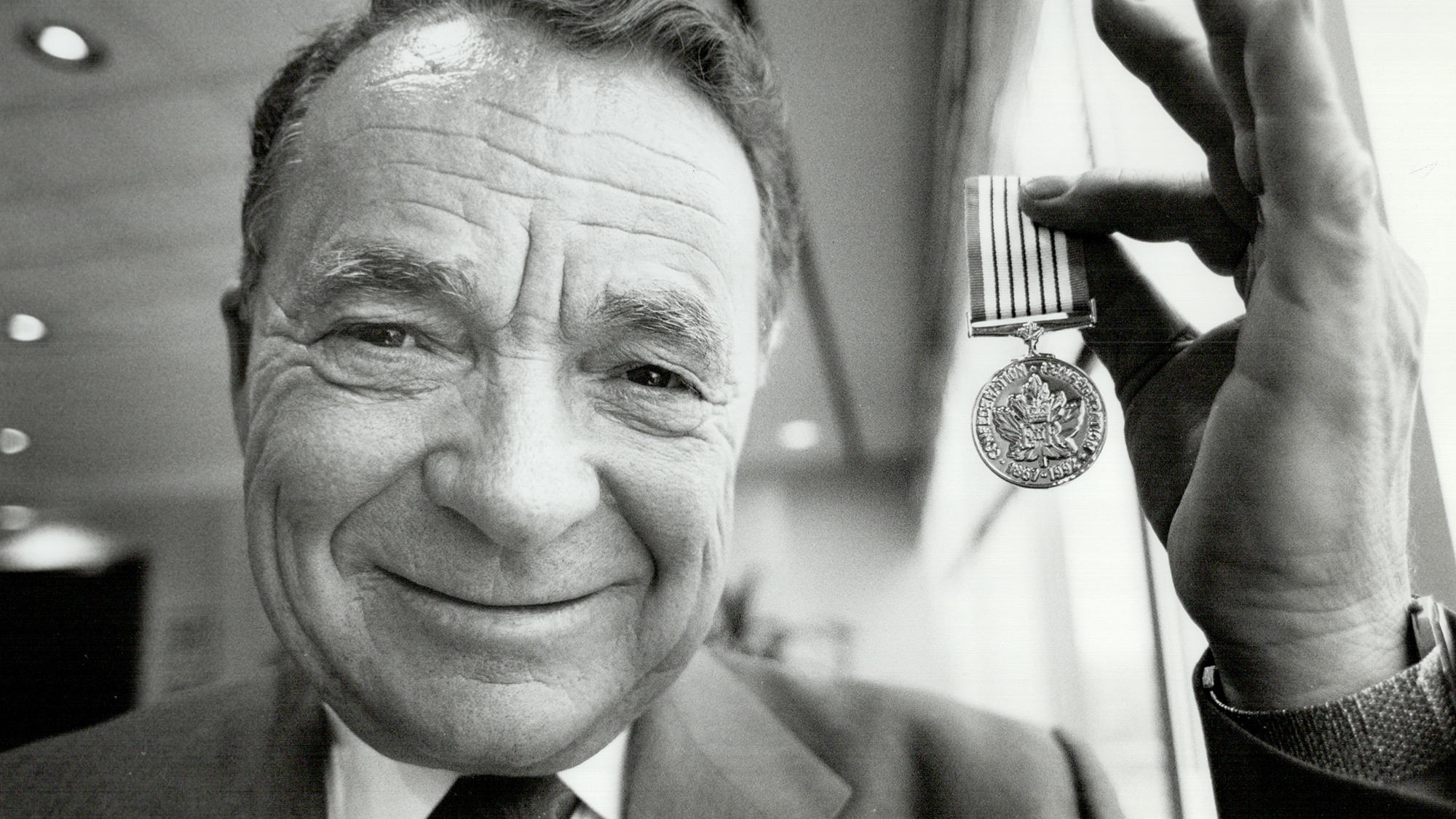
CANADA – DECEMBER 18: Medal of devotion: Developer Ignat Kaneff shows off the commemorative medal received from the federal government for his community service. (Photo by Andrew Stawicki/Toronto Star via Getty Images)
“Iggy Kaneff and the Kaneff family have been passionate builders, operators and supporters of the game of golf,” said Golf Canada CEO Laurence Applebaum. “As a young professional in the golf industry in the early 90’s, I had the great fortune of getting to know and playing golf with Iggy at his signature golf courses during a very exciting time of growth for the game he loved. He was kind, entertaining and had an aura of energy that surrounded everything he was involved with.
The Kaneff Golf collection of signature courses have contributed greatly to the golf experience across southern Ontario and those facilities have hosted countless charity tournaments and fundraisers that have supported so many important and worthwhile causes. What is most inspiring about Iggy’s legacy is that he was a philanthropic champion celebrated for his generosity and tireless efforts in giving back to his community. He will be sorely missed.”
Canadians playing more golf in 2020 once COVID 19 restrictions lifted

If it seems like it’s been harder to get a tee time this summer, it’s not just your imagination.
Golf Canada reports that there were 17 per cent more scores registered with the national sport body this June compared to the same month last year. A total of 1,483,506 rounds were submitted to Golf Canada’s handicap calculator last month compared to 1,271,782 in June 2019.
“It was a pretty big jump from last year, comparing 2019 numbers to this year,” said Adam Helmer, senior director of golf services for Golf Canada, on Wednesday. “We were expecting that as golf has emerged as one of the safest activities, where people can be physically distant and we’ve reduced touchpoints.”
The surge in June ended a streak of three months when recreational rounds played in Canada dropped precipitously due to the COVID-19 pandemic.
As restrictions were lifted across the country in May, the number of scores registered increased.
In May, 165,026 rounds were registered between the 1st and the 15th but 265,480 scores were submitted in the final two weeks of that month. The May 1-15 numbers are a nearly 40 per cent drop from the same period in 2019 (211,809) but the May 16-30 numbers are just five per cent lower than last year (269,266).
Helmer said he expects the number of rounds submitted to Golf Canada to continue to climb through July and into August.
“We’ve heard anecdotally that a lot of newcomers have joined the sport, especially now that school is done we’re going to see an increase in juniors too. We think the trend is going to continue,” said Helmer. “Golf has seen a pretty big lift and it’s emerged as the sport of the summer.”
The upward trend comes even as Golf Canada had to cancel all of its amateur and professional championships due to travel restrictions put in place to slow the spread of the novel coronavirus.
A shift in how scores are registered has also been seen, with most recreational players entering their scores online instead of in the course’s clubhouse or pro shop, which have largely been closed this summer because of physical distancing protocols.
Golf Canada plans to launch an updated version of its scoring app later this month, helping to keep players physically distant and improve their game.