


Tips on working at home from Team Canada’s psychologist

Team Canada psychologist, Dr. Adrienne Leslie-Toogood, shares the below guidance and resources to help with our work from home activities.
As you work from a different place in an ever-changing reality, below are a few reflections from high performance sport. Three aspects I will highlight: who do you want to be, how do humans work, and prioritize recovery.
Who do we want to be?
In working with golfers, we often start with helping them understand who they are and who they want to be in certain situations. This whole idea came from an experience I had when I first moved back to Canada. I had one athlete who was quite young and traveled a great deal internationally. At times, she was very good at what she did and at other times she really struggled. A more experienced competitor sat down with her to have a conversation. He asked her if she knew who she was. She said that she was not sure. And he said that she needed to figure it out, so that she knew if she was in that place each time she stepped to the line.
As you work from home in a new reality, spend some time reflecting on who you want to be in this new context. What do you need to be well in this space? What do you need to stay motivated?

Below are suggestions and tips that other experts have developed for working-from-home (jasonthompson.ca)
- Video calls are a great way to feel connected
- It’s easy to get lost in texts, emails and social media. Set aside two times per day when you go through these. Focus on your to-dos the rest of the time.
- Buy a plant for your workspace. It just feels good.
- Go for a walk. It reboots your mind. Some of my best ideas have come on walks.
- Set a start and end time each day.
- Take advantage of the flexibility and extra work time without a commute.
- Dress for work. This may not be the same as your in-office outfit, but if you wear your weekend sweats it will have an effect on your mindset.
- Chat about life. Start every call with a few minutes about non-work things and non-COVID things if you can. Remember, we work with people not organizations.
- Shared documents are awesome – try and pick one platform and stick with it.
- Connect with your team once a day.
- If you work from home, despite how wonderfully tempting they can be, don’t get distracted by laundry and tidying up. Do that when your workday is over.
- Embrace the situation. If life has taught us anything, it’s that nothing stays the same for long.
Working in high performance sport, we also spend a great deal of time helping a golfer unpack their why. Their reason for doing this and putting in all the hours. In your current context, I think we can extend your why to another level. As we work in these new conditions, what is your why for doing it? Who is your why? Grab a few pictures that remind you of this and keep it close to you.

Adrienne Leslie-Toogood, Derek Ingram
Finally, understanding when we are and are not in a good place from a mental wellness perspective can be beneficial. Below is a mental health continuum that I modified for Team Canada men’s golf team (based on a more elaborate version from the Canadian Mental Health Association). It helps all of us start to learn about when we are mentally well. We should all know the things that keep us well, the signs we are not well, triggers and what we can do to get back to being well.


How do humans work?
We help athletes understand how humans being work. Stress and anxiety are a part of being human. Humans have a brain that is meant to help us survive and as such, we respond to stress and anxiety in a certain manner. We thrive with control, and in times like this, it is very important that we spend time coming back to what we have control over.
Click here to watch a TedTalk by Lisa Feldman Barrett that helps us learn more about the brain and how it operates.
Click here to read an article that talks about anxiety as it related to the situation. There is also a colouring book you can use to speak with coronavirus for those of you who have young children.
Prioritize recovery
And finally, we try to prioritize recovery. Our sport science team speak about being physically and also mentally recovered with Team Canada golf. Meditation and mindfulness can be very helpful tools for keeping us in a positive mental space. Some things to consider as we work to prioritize emotional recovery:
Be self-compassionate. Even people who don’t usually struggle with anxiety are experiencing more worry and anxiety now. Don’t be too hard on yourself if you’re experiencing more anxiety than usual. Additional information regarding self-compassion can be found here as well as several free tools and activities to aid in practicing kindness to ourselves.

Limit the news and unplug from social media. Understandably coronavirus is the lead story for most news outlets. People on social media are likewise sharing information and stories, some of which are accurate, but others may have little to do with reality. The general public is interested and wants to know the latest details. Yet when our attention is drawn to something, we are more likely to focus on it and continue thinking about it. As we think about and focus more on coronavirus, the PERCEPTION of threat increases (not the actual risk but our perception of it).
If you do watch or read the news, try to limit how often you:
- Commit to only checking in a couple of times a day and limit the total time to 30 minutes a day.
- Set a regular time when you check the news every day (standardizing the times you check will help to both think less about it and to reduce fighting with yourself to check).
- Disable news alerts on your phone so that you get updates when you want them. It can also be helpful to rely on family and friends to provide major updates thereby making it unnecessary to check the media.
- Make sure that your information only comes from reputable sources, such as: Government of Canada and the World Health Organization.
Strengthen Self-Care. During these anxiety-provoking times, it’s important to remember the tried-and-true anxiety prevention and reduction strategies: (Get adequate sleep; Exercise regularly; Practice mindfulness; Eat well-balanced meals; Make time for activities you enjoy and take time to unwind; Spend time in nature; Employ relaxation techniques when stressed; Connect with people you trust; and talk about your concerns and how you are feeling).
Focus on What You Can Control. Sometimes we fixate on events out of our control. But rather than blaming others or trying to change them, resilient people set their sights on what they can control. Ask yourself, “What can I control in this situation?”
Be in the Present. What do you notice about your breath right now? Our breath is an excellent anchor in the present, but sometimes we get stuck in the past or worry about the future. Practice STOP (Stop. Take a few deep breaths. Observe. Proceed).
So as you work from home and continue to do your job, keep figuring out who you are and who you want to be, honour the fact that you are human and prioritize recovery – knowing that right now the conditions are such that it may be difficult to let go and allow your mind to be at rest.
Canada’s sports organizations eager to unite country when pandemic passes

Tom Renney remembers exactly where he was during the attacks of Sept. 11, 2001.
It was the first time the New York Rangers had ever held their training camp in Manhattan. Renney, who was entering his second season as the team’s director of player personnel, was at Madison Square Garden as players checked in for their physicals when the first plane struck the World Trade Centre.
The spectre of 9/11 still haunted New York City four years later when Renney began his first training camp as the Rangers’ head coach. Sensing that the Rangers could be a rallying point for a hurting city, Renney told his team that they had to play the 2005-06 season for the fans.
“You know what? We owe this city and we owe the New York Rangers fans everything we have,” Renney recalls. “This is not about hockey, this is about allowing a city that supports us like nobody else the chance to feel good, and feel like there’s a rebound and feel like there’s something that they can feel good about.
“I said, that is our responsibility and our obligation to the Rangers fan. And quite honestly, you know, the National Hockey League.”
That season the Rangers became the first team to do a post-game stick salute to thank their fans, a practice that is now common around the NHL. Renney led the team to a third-place finish in the Atlantic Division and New York’s first playoff berth since 1997.
Renney is now the chief executive officer for Hockey Canada and although he doesn’t know when professional or amateur sports will return, he says that like his time with the Rangers, they will play a critical role in healing the country when the COVID-19 pandemic ends.
“I believe Canadians are very resilient people. I think the hockey community is a resilient group, not just those that play it, but those that love watching it,” said Renney. “When the time is right, I think our participants and volunteers across the country will relish the role in leading Canada back to normal.”
Hockey, like all elite sports, is on hold as officials do their bit to help stop the spread of the COVID-19 virus. The NHL has paused its season and the Memorial Cup, Canada’s national major junior championship, was cancelled along with the Canadian Hockey League’s playoffs.
There’s no telling when the NHL, NBA, Major League Baseball, CFL or any other professional sport will return. But like Renney, Golf Canada CEO Laurence Applebaum says his sport will be ready to unite Canadians when restrictions on public gatherings are lifted.
Also like Renney, Applebaum has seen firsthand how sports can bring a community together after a tragedy.
Applebaum was the vice president of Salomon Canada, a sports equipment manufacturer, a decade ago and was in Vancouver for the 2010 Winter Olympics. He remembers a literal and figurative cloud hovering over Vancouver after Georgian luger Nodar Kumaritashvili was killed during a training run hours before the Games opening ceremony.
“The sport community came together to mourn him and the weather changed and it ended up evolving into an incredible celebration of sport and humankind coming together,” said Applebaum. “So my prevailing theory is the sun will rise again (when the pandemic is over).
“And golf, golf will rise again and return to being an incredible part of our lives. It’s just going to take some time.”
Bruce Kidd, a historian and professor at the University of Toronto, believes that sports are in a unique position to help rally cities or countries after disasters because people can identify with the athletes. That power will become even more apparent when normalcy returns after the novel coronavirus pandemic is over.
“I think to which athletes and coaches’ lives have been thrown into complete disarray is something that most people can identify with right now,” said Kidd, who competed for Canada at the 1964 Olympics and was twice named The Canadian Press athlete of the year.
Kidd, who likened the current public health emergency to the Spanish influenza pandemic of 1918-20, says that when sports return it will be cathartic for all of society because it will be a celebration of overcoming adversity.
“It will be a relief, it will signal a return to some kind of normalcy,” said Kidd. “It’ll be an opportunity for people to take control of their lives again, whether it’s participating in sports or watching them.
“Psychologically, it will be empowering and I think that’s really important.”
Statement from ‘We Are Golf’ about COVID-19

We Are Golf (The National Allied Golf Associations/NAGA) are committed to ensuring the health and safety of our members, golfers, staff, volunteers and industry stakeholders as well as every Canadian in the communities where we live, work and play.
The COVID-19 crisis is an unprecedented and difficult time for Canadians. We Are Golf fully supports the recommendations and guidelines of Health Canada, the World Health Organization and regional public health experts to stop the community spread of the virus. As leaders in an industry that employs more than 300,000 Canadians and includes nearly six million golfers from coast to coast, our priority above all else is the health and safety of our people and our communities.
Where governments have not mandated the temporary closure of golf courses, operators of those facilities should take every health and safety precaution. We Are Golf also advocates for the essential need for golf course property maintenance during any of the temporary closures to be ready for operation while taking every health and safety precaution.
We look forward to better and healthier days and when the time is right for Canadians to return to recreational normalcy, clubs and courses will be ready to welcome golfers back to the tee.
Tokyo Olympics officially postponed until 2021

TOKYO – The Tokyo Olympics were postponed until 2021 on Tuesday, ending weeks of speculation that the games could not go ahead as scheduled because of the coronavirus pandemic.
The International Olympic Committee made the decision after speaking with Japanese Prime Minister Shinzo Abe and local organizers.
The IOC said the games will be held “not later than summer 2021” but they will still be called the 2020 Tokyo Olympics.
“In the present circumstances and based on the information provided by the WHO today, the IOC President and the Prime Minister of Japan have concluded that the Games of the XXXII Olympiad in Tokyo must be rescheduled to a date beyond 2020 but not later than summer 2021, to safeguard the health of the athletes, everybody involved in the Olympic Games and the international community,” the IOC said in a statement.
Before the official announcement, Abe said Bach had agreed with his proposal for a one-year postponement.
“President Bach said he will agree `100%,’ and we agreed to hold the Tokyo Olympics and Paralympics in the summer of 2021 at the latest,” Abe said, saying holding the games next year would be “proof of a victory by human beings against the coronavirus infections.”
On Sunday, Bach said a decision on postponing the games would be made in the next four weeks. But pressure grew as national federations, sports governing bodies and athletes spoke out against having the opening ceremony as planned on July 24.
Four-time Olympic hockey champion Hayley Wickenheiser was the first IOC member to break ranks with Bach’s stance that the games would go ahead as planned when she publicly criticized the body’s unwavering strategy.
After the announcement to postpone the game, she wrote on Twitter that the decision was the “message athletes deserved to hear.”
“To all the athletes: take a breath, regroup, take care of yourself and your families. Your time will come,” she wrote.
The decision came only a few hours after local organizers said the torch relay would start as planned on Thursday. It was expected to start in northeastern Fukushima prefecture, but with no torch, no torchbearers and no public. Those plans also changed.
“For the time being, the flame will be stored and displayed in Fukushima,” organizing committee president Yoshiro Mori said.
The Olympics have never before been postponed, and have only ever previously been cancelled in wartime.
Organizers will now have to figure out how to keep things running for another year, while making sure venues are up to date for possible another 12 months.
“A lot can happen in one year, so we have to think about what we have to do,” said Toshiro Muto, the CEO of the organizing committee. “The decision came upon us all of a sudden.”
The IOC and Tokyo organizers said they hope the decision to postpone will help the world heal from the pandemic.
“The leaders agreed that the Olympic Games in Tokyo could stand as a beacon of hope to the world during these troubled times and that the Olympic flame could become the light at the end of the tunnel in which the world finds itself at present,” the IOC statement said. “Therefore, it was agreed that the Olympic flame will stay in Japan. It was also agreed that the Games will keep the name Olympic and Paralympic Games Tokyo 2020.”
Golf Canada Statement on the Canadian Olympic Committee’s Decision to Not Send Team Canada to the 2020 Tokyo Olympic Games
Based on the continued information being received from the World Health Organization (WHO) and the International Olympic Committee (IOC), the Canadian Olympic Committee recognizes that due to the COVID-19 global pandemic, it is not safe for athletes to train in their ordinary training environments to prepare for the upcoming Tokyo 2020 Games.
Therefore, for the health and safety of our Canadian athletes, Canada will not be in a position to send a team to the 2020 Tokyo Olympic Games starting on July 24 or the immediate period thereafter. The Canadian Olympic Committee will continue to encourage the International Olympic Committee to postpone the Tokyo Games for one year.
Golf Canada is fully aligned with the position of the Canadian Olympic Committee and will continue to work with our Olympic sport partners to ensure that the health and safety of athletes is the number one priority.
Click here for the full statement from the Canadian Olympic Committee
Team Canada will not send athletes to Games in summer 2020 due to COVID-19 risks

TORONTO – The Canadian Olympic Committee (COC) and Canadian Paralympic Committee (CPC), backed by their Athletes’ Commissions, National Sports Organizations and the Government of Canada, have made the difficult decision to not send Canadian teams to the Olympic and Paralympic Games in the summer of 2020.
The COC and CPC urgently call on the International Olympic Committee (IOC), and the International Paralympic Committee (IPC) and the World Health Organization (WHO) to postpone the Games for one year and we offer them our full support in helping navigate all the complexities that rescheduling the Games will bring. While we recognize the inherent complexities around a postponement, nothing is more important than the health and safety of our athletes and the world community.
This is not solely about athlete health – it is about public health. With COVID-19 and the associated risks, it is not safe for our athletes, and the health and safety of their families and the broader Canadian community for athletes to continue training towards these Games. In fact, it runs counter to the public health advice which we urge all Canadians to follow.
The COC and CPC reviewed the letter and news release sent Sunday by the IOC. We are thankful to the IOC for its assurance that it will not be cancelling the Tokyo 2020 Games and appreciative that it understands the importance of accelerating its decision-making regarding a possible postponement.
We also applaud the IOC for acknowledging that safeguarding the health and wellness of nations and containing the virus must be our paramount concern. We are in the midst of a global health crisis that is far more significant than sport.
The COC and CPC would like to thank our athletes, partners and the Canadian sport community for their patience and for lending us their voices during these unprecedented times. We remain hopeful that the IOC and IPC will agree with the decision to postpone the Games as a part of our collective responsibility to protect our communities and work to contain the spread of the virus.
Click here for Golf Canada’s statement on the Canadian Olympic Committee’s decision to not send Team Canada to the 2020 Tokyo Olympic Games.
Golf Canada Statement re: heightened global concerns surrounding COVID-19

With heightened uncertainty and global concern related to COVID-19, Golf Canada is evaluating all aspects of our business to operate and make decisions within the best interests of our staff, volunteers, athletes, partners and other stakeholder’s health and well-being.
We are monitoring Health Canada, the World Health Organization and other expert governmental/regional health experts to follow developments and receive guidance.
We are also consulting with key partners including the PGA TOUR, LPGA Tour, Canadian Olympic Committee and other national/international sport and entertainment properties to make informed and responsible decisions.
Canada’s Marchand off to strong start on Symetra Tour after considering retiring

Brittany Marchand was ready to call it quits.
She was worn down and frustrated after a disappointing sophomore season on the LPGA Tour. Marchand didn’t touch her clubs for three weeks after the final event in November and spoke with family and friends over the off-season about what she should do next.
“I came off of a really tough year and I was not in a very good place after the end of last year,” said Marchand, who missed all but one cut in 2019, tying for 55th at the Thornberry Creek LPGA Classic in July.
That meant if Marchand was going to return to pro golf it would be on the second-tier Symetra Tour and she would have to earn her way back on to the top-flight LPGA Tour for the 2021 season. After some soul searching, the native of Orangeville, Ont., decided to give it another try.
“I wanted to give it my all this off-season and putting in the work and then actually seeing it pay off in the first event is definitely a good feeling,” said Marchand, who finished in a tie for eighth at the season-opening Florida’s Natural Charity Classic last weekend. “I feel like Brittany again. It’s nice to feel that again and remember that, you know, I do like golf.”
One of the people Marchand consulted with was fellow Team Canada Young Pro Squad member Anne-Catherine Tanguay, who herself is on a one-year leave of absence from the LPGA. Tanguay encouraged Marchand to take another run at it and, if necessary, end her career on her terms.
“It’s a long year, and it’s a grind, especially if you have to play on the Symetra Tour,” said Quebec City’s Tanguay, who is pregnant with her first child. “It’s a commitment to do. It’s a life choice to travel and live in your suitcases and I think to do it you have to have the passion for it.

“That’s also something that we touched upon. You just have to want it so when it’s not there anymore, maybe you need to ask yourself other questions. But if you still feel like you have some great golf in you and you still have the passion, I think you should go for it.”
Marchand, who is based outside of Raleigh, N.C., plans to play in the IOA Championship presented by Morongo Casino Resort and Spa in Beaumont, Calif., starting March 27. It’s the second event of the Symetra Tour season and, on the way out there, she’s going to try the Monday qualifier for the LPGA’s Volvik Founders Cup in Phoenix.
“I obviously know that I can play on the LPGA. It was tough to not believe in myself last year,” Marchand said. “It’s worth giving myself another shot. To be out there and no matter how the year ends, I think I’ll feel better if I walk away from golf next year.
“I think I’ll feel like it was the right way rather than if I left last year, I think maybe down the road I would have regretted it.”
A relaxed McIlroy looks to continue winning ways as golf’s top player

PONTE VEDRA BEACH, Fla. – It’s been quite the stretch of golf for Rory McIlroy since last year’s RBC Canadian Open.
McIlroy, who is the defending champion at The Players Championship this week at TPC Sawgrass, rode the momentum from his win in Florida to Hamilton and onwards to topping the FedEx Cup standings for the second time.
He went on to win Player of the Year honours on the PGA Tour.
Although McIlroy hasn’t seen much of Canada – he went to Toronto for four days after playing the PGA Championship at Whistling Straits in 2015 to see his friend Nail Horan (yes, the lead singer of uber-popular boy band One Direction) play a concert and he said he would love to see Vancouver one day – he certainly made a big impact a year ago.
The 30-year-old blitzed the field at the 2019 RBC Canadian Open, finishing with a 9-under 61 Sunday. He topped Shane Lowry and Webb Simpson, who tied for second, by seven shots. It was a crowning of sorts for the young Ulsterman, as, for a week, he was the King of Canada.
Right back at ya, @McIlroyRory!
Cheers, champ ? pic.twitter.com/WIotjSqxvm
— RBC Canadian Open (@RBCCanadianOpen) June 10, 2019
McIlroy has been the king of the golf world for a little longer than just a week, however.
As of this week at The Players, McIlroy has been on top of the world golf rankings for a clean 100 weeks in his career.
“I’m very proud to think that I’ve spent two years of my career at the top of the World Rankings. It’s a pretty nice feeling,” said McIlroy on Tuesday at Sawgrass.
Although he admitted reaching No. 1 this time around was anti-climatic – he essentially got to the top spot via a mathematical formula and not by a particular accomplishment – he said he still managed to find time to celebrate the milestone with his caddie and best friend, Harry Diamond, who took over McIlroy’s bag in 2017.
“We’ve been on that journey together from sort of injuries and not playing my best all the way back to the top of the world,” said McIlroy. “So it was important for me to sit down and have a few drinks with him and be like, you know, ‘we’ve done this, this was our journey and we did it, two guys that grew up in Holywood, Northern Ireland, playing golf together,’ and that we’ve done this is something that was really cool.”

Indeed, McIlroy has had much to celebrate over the last 12 months, including his victory at the RBC Canadian Open.
In an interview in January, McIlroy said, for the first time in his life, he’s feeling very settled. He turned 30 in 2019 and has a new home base in South Florida with his wife, Erica. He took a holiday over Christmastime for the first time in forever, he said. He’s trying to travel less. He’s enjoying the little things in life like a good book and a nice bottle of wine.
After winning the FedEx Cup last year, he gave himself the opportunity to think back to the year-that-was and recognize his accomplishments.
“This year it was very nice to enjoy downtime. I played a lot (in 2019) and I played well and I wanted to enjoy some time and reflect on a good year I feel very settled, very balanced, it’s been nice to spend time at home and do that as well.”
McIlroy comes into this week at The Players playing some magical golf. So far this season McIlroy has finished T3-1-T3-T5-5-T5.

Still, McIlroy is not one to be complacent.
“I think the only way to not win is to concentrate on the results,” he said. “So if I can just concentrate on what I’m doing and what I’m doing well, what I maybe need to improve on a little bit, just break the game down into different sections but really just try to make it as simple as possible, if I can do a few different things in my golf game just a little bit better, those thirds and fifths will hopefully turn into wins.”
No one has ever defended their Players Championship title, but if anyone could make it happen – and considering how well he’s playing coming into the week – it would be McIlroy.
“If there’s been no one to defend, it would be a nice time to start and have someone do that,” said McIlroy. “A lot of similarities between this year and last year in terms of how I’ve played the first few events of the year, given myself some chances, haven’t quite been able to capitalize, and obviously it would be wonderful to replicate what happened last year.”
Your golf handicap is changing – find out why it matters

Welcome to Golf Handicaps for Dummies: Why having a handicap is not a handicap.
No, I’m not calling you a dummy, but if you’re a golfer of any ability who doesn’t maintain an accurate and consistent handicap, you’re not taking advantage of one of the fundamentals that makes golf the most democratic of sports. And that’s just dumb.
With all due respect, you can’t go one-on-one with a pro basketball player or hope to score on an NHL goalie. They’re not going to let you shoot at a basket that’s lower than regulation or a net that’s 10 feet wide and six feet high.
But golf’s handicap system allows you to compete on an equitable basis with players who are more or less accomplished than you are. Maintaining a handicap also allows you to monitor your progress every time you play. It’s an integral part of your golf experience.
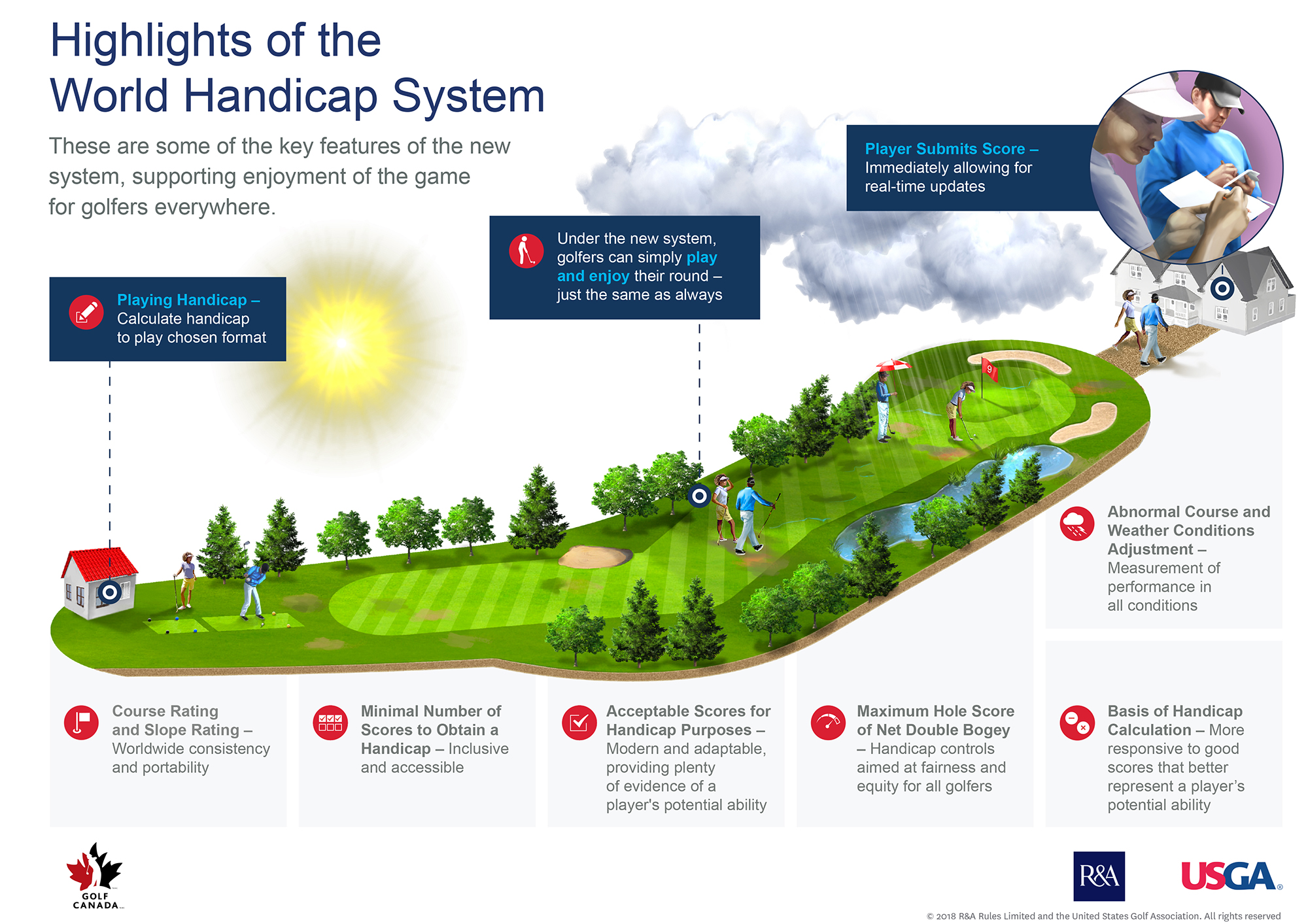
And, starting Jan. 8, the new World Handicap System makes that scenario even more attractive. More user-friendly, in other words.
“The new system gives golfers an increased opportunity to have fun and compete equitably across all skill levels and ages,” says Shaun Hall, Golf Canada’s senior manager of handicap & course rating.
“You don’t have to be a competitive golfer. If you simply enjoy playing, having a handicap makes the game more enjoyable and allows you to track whether you’re improving.”
I reached out on Twitter with the question, “Do you maintain a handicap and why?” and received some testimonials.
Ontario golfer Donal Byrne says, “I’m a huge fan of keeping a handicap. I was thrilled to have closed the season inside of 20 [Handicap Index] for the first time. We should celebrate everyone who plays, no matter how they play. I just won’t play anyone who doesn’t have a handicap for money!”
And from Charlottetown, Jeff Craig, whose Twitter profile says he’s “dedicated in my quest to break par,” says, “It bugs the Hell out of me when someone [without a handicap] says, ‘Well, I usually shoot in the mid-80s and wants to play for something.’”
On a personal note, my wife loves the game and posts every score. Her pride in seeing her handicap decrease is evident. Because she is diligent about maintaining her handicap and improving her skills, she was able to win the ladies’ net championship at her club. As a side note, she plays annually in a member-guest at another club where you must have an official Golf Canada Handicap Index to participate.
When she first took up golf, she had waffled about establishing a handicap because, in her words, “I don’t think I’m good enough to have a handicap.”

And that’s the most common excuse recreational golfers give for not caring about a handicap. “I’m not good enough.” Hall disputes that, especially given the fact that under the new system the maximum Handicap Index (which replaces the previous “Handicap Factor” in Canada) has been raised to 54.0 for both men and women. Previously, it was 36.4 for men and 40.4 for women.
Another significant change is to Equitable Stroke Control (ESC). Starting in 2020, net double bogey on any hole is the maximum allowed, whether it’s a par 3, par 4 or par 5. So, for handicap purposes, you can count a maximum of two strokes over par plus any strokes you are entitled to, based on the stroke allowance for that hole.
Obviously, from its name, the World Handicap System is now accepted globally, meaning the same parameters are in place no matter where you play, a boon for Canadians who travel and golf outside the country. As before, all scores can be conveniently posted on the Golf Canada Score Centre, club kiosk or Golf Canada app from your phone or tablet.
3 more significant innovations
- Only three 18-hole scores (or the equivalent combination of nine-hole scores) are needed to establish a Handicap Index. Previously, the minimum was five. What golfer doesn’t play more than 54 holes in a season?
- Only eight of your lowest 20 most recent scores will be used to calculate your Handicap Index, rather than the previous 10.
- And a Playing Conditions Calculation will analyze how you played that day compared to your expected performance on that particular course, taking into account weather and course setup.
Don’t ask me how that last one works, because I’m a tech dummy.
Click here to purchase the official Rules of Handicapping book.
But even if you don’t, don’t be a dummy. Take advantage of the new World Handicap System in 2020.