


9 things to know about golf’s new World Handicap System

The idea for a new, unified system was conceived by the USGA and The R&A and developed following an extensive review of systems administered by six existing handicapping authorities, going into effect on January 1, 2020. Here are nine things to know about the new system:
1. The World Handicap System (WHS) supports golf globally
Golf already has a single set of playing Rules, a single set of equipment Rules and a single set of Rules of Amateur Status overseen by the USGA and The R&A. Yet, today there are six different handicap systems used around the world. Each is well developed and successfully provides equity for play locally, but each of the different systems produces slightly differing results. The WHS will unify the six systems into a single system that will:
- enable golfers of different ability to play and compete on a fair and equitable basis, in any format, on any course, anywhere around
- be easy to understand and implement, without sacrificing accuracy; and
- meet the varied needs and expectations of golfers, golf clubs and golf authorities all around the world and be adaptable to suit all golfing cultures.
After significant engagement and collaboration with the existing handicapping authorities and other National Associations, it has been agreed that the time is right to bring the different handicapping systems together as a fourth set of Rules, in support of the global game. In addition, this project has provided an opportunity for the existing handicapping authorities to come together and share their combined experiences to produce a system which is modern and relevant for the way the game is played today around the world. The WHS will encompass both the Rules of Handicapping and the Course Rating System (formerly the USGA Course Rating and Slope System).
2. There are many benefits to the World Handicap System.
As the world becomes a smaller place with a much greater frequency of international play (as demonstrated by golf returning to the Olympics in 2016), we believe the development of a single handicap system will result in easier administration of international events and, potentially, allow National Associations more opportunity to focus attention on golf development and strategic planning to support the sport. It would also provide the opportunity to evaluate de-personal golfing data to help monitor the health of the game.
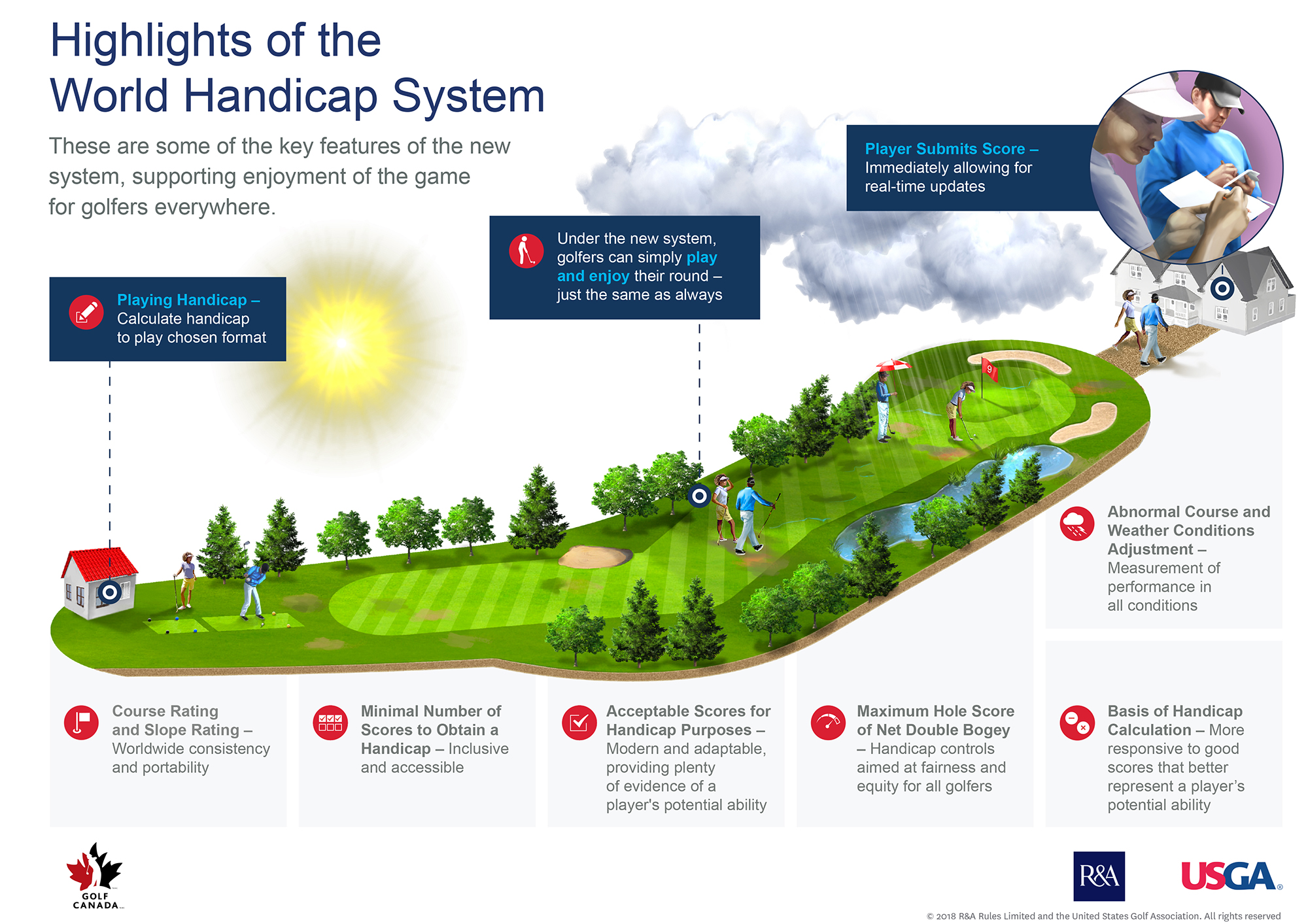
3. Existing scoring records will be retained.
Existing scoring records will be retained and, where possible, be used to calculate a handicap under the WHS. For most players, their handicap will change only slightly as they will be coming from systems which are generally similar to the WHS. However, this will be dependent on many factors – including the number of scores available upon which the calculation of a handicap can be based. National Associations are being encouraged to communicate this message to clubs and golfers, i.e. that the more scores available in the scoring record at the time of transition, the less impact golfers will feel on their handicap.
4. It is tailored to accommodate all cultures.
It is not our intention to try to force a change on the way that golf is played around the world or to try and remove the variations. The cultural diversity that exists within the game, including different formats of play and degrees of competitiveness, is what makes the sport so universally popular. Through collaboration with National Associations, the goal has been to try to accommodate those cultural differences within a single WHS.
5. All six handicapping authorities are fully behind the new system.
A series of briefing sessions was conducted all around the world in 2015, which aimed to cover as many National Associations as possible. The reaction was very positive. It is also worth emphasizing that the development of the WHS is a collaborative effort and all the existing handicapping authorities and National Associations who are directly involved in the process are very supportive of the initiative. Each of the six existing handicapping authorities have recently gone through their own internal approval processes, and all of them have confirmed their support for the new system. While the USGA and The R&A will oversee the WHS, the day-to-day administration of handicapping will continue to be the responsibility of the existing handicapping authorities and individual National Associations.
6. Feedback from golfers helped shape the new structure.
We have solicited the opinions of golfers and golf club administrators all around the world via an online survey, to which we received over 52,000 responses. We have also conducted focus group sessions in five markets throughout Europe, the USA and South America. The reaction was overwhelmingly positive; for example, 76% surveyed are supportive, 22% undecided at this stage and only 2% opposed.
7. The WHS goes into effect on January 1, 2020.
We are planning to make the WHS available for implementation by National Associations beginning in January 2020, after an extensive schedule of testing, communication, promotion and education.
8. More golfers will be encouraged to play the game.
Further details of the WHS will emerge over the coming months. However, we want to emphasize that it is being designed to be as accessible and inclusive as possible, while still providing golfers with the portability, accuracy and consistency they expect. Offering a couple of examples, golfers will be able to obtain a handicap after returning a minimal number of scores – the recommendation being as few as three 18-hole scores, six 9-hole scores or a combination of both to comprise 54 holes. Handicaps will not lapse after a period of inactivity and the maximum handicap will be 54.0, regardless of gender. These elements are designed to clear a pathway into the game, enabling players new to the sport to feel more welcomed into the golf community. While the WHS is intended to encourage more golfers to measure and track their performance, it must enhance the enjoyment of all golfers. Therefore, it will be important for clubs to ensure that new golfers with higher handicaps pick up at the maximum hole score and maintain a good pace-of-play.
9. National Associations are tasked with educating the golf community.
The education roll-out is scheduled to commence in January 2019, and we have already started to work on a strategy for the development of a ‘global-ready’ education plan to support implementation and ongoing operations. National Associations will continue to carry out the responsibility of educating its membership.
Hughes follows his own advice at Valspar Championship for best finish of season

Mackenzie Hughes is used to giving other people advice on the PGA Tour this season. Last week, the Canadian started listening to it himself.
Hughes, from Dundas, Ont., had missed the cut at four consecutive events but after giving himself a pep talk, he had his best result of the season at the Valspar Championship, tying for 13th at 3-under par in Palm Harbor, Fla.
“I was a little down on myself, I’d lost a little bit of confidence, but it wasn’t for lack of a physical game,” said the 28-year-old Hughes. “I told myself to just go out on the golf course and trusting my abilities and giving myself some pep talks out there.
“It sounds kind of silly and very simple but that was pretty much it, just a bit of proper self-talk, trying to keep myself pumped up, not getting down on myself.”
After psyching himself up last Wednesday, Hughes shot a 70-72-68-71 at the Valspar and moved up the FedEx Cup standings 29 spots to 158th.
It’s ironic that it took some self-talk for Hughes to pull out of his slump since he’s become a bit of a sage on the PGA Tour this season. In January, he helped Corey Conners of Listowel, Ont., adjust his putting, helping the fellow Canadian shoot a 64-64 that weekend to tie for third at the Sony Open in Hawaii.
“I still haven’t gotten my coaching fee for that yet,” joked Hughes. “I’m sure it’s in the mail.”
On Tuesday, Hughes and David Hearn of Brantford, Ont., played a practice round ahead of the Corales Puntacana Resort & Club Championship in the Dominican Republic. They were joined at the 10th tee by former Dallas Cowboys quarterback Tony Romo, who will also be in the field that tees off on Thursday.
Hughes enjoys helping his fellow golfers in part because it helps him understand his own game better.
“There’s definitely things that I have to try and remind myself of when I’m telling Tony something, or if I’m telling a young junior some thoughts on how to approach the game,” said Hughes. “It sometimes serves as a good reminder that yeah, this is the stuff I need to think about and these are the things I do when I’m playing my best.”
Hughes, Conners, and Hearn will be joined in the Corales field by Ben Silverman of Thornhill, Ont., Roger Sloan of Merritt, B.C., and Adam Svensson of Surrey, B.C.
It will be a tightly contested tournament, with some of the bigger names on the PGA Tour participating in the World Golf Championships-Dell Technologies Match Play. No Canadians are in the field at that event, which is headlined by Tiger Woods, Dustin Johnson and Rory McIlroy.
Golf Canada appoints Jeff Hutt as Regional Director in Atlantic Canada

Golf Canada is pleased to announce that Jeff Hutt of Fredericton, NB has been appointed as Golf Canada’s full-time Regional Director in Atlantic Canada.
Jeff, who was previously splitting his time between Golf Canada and his position as Director of Marketing with Golf New Brunswick, will now focus his time to better serve member clubs and support the execution of Golf Canada’s non-affiliated player strategy Atlantic Canada.
Jeff’s depth of industry insight, past experiences and established network of club contacts across the region will help strengthen the collaborative relationship between Golf Canada and the Atlantic Provincial Golf Associations while delivering enhanced service to our member clubs.
“I am really excited to be joining Golf Canada in a full-time capacity. “As I expand my role, my focus is to work with our provincial associations to better support our partner facilities in the implementation of our programs and services. I also look forward to helping grow an enhanced member experience for both non-affiliated players and members of partner facilities.”
Born in Halifax, N.S., Jeff moved to Fredericton, N.B. where he grew up in a golfing family. He was a member at Fredericton Golf Club where he participated in the junior program. As a teenager, he worked as a summer student at Kingswood Golf Course and went on to Holland College in P.E.I. where he enrolled in their Golf Club Management Program. After graduation, he returned to the University of New Brunswick to earn a degree in Hospitality and Tourism.
Over his 19-year career, Jeff has developed a strong skill set and industry network across the golf industry in New Brunswick and Atlantic Canada. He spent 10 years at Kingswood Resort in various roles before joining Golf New Brunswick as Manager of Marketing and Junior Programs. Over the next nine years, he held various roles with Golf N.B. including his most recent position as Director of Marketing. In 2015, Jeff added to his responsibilities and worked with Golf Canada on a part-time basis as the Regional Director for Atlantic Canada.
Jeff remains an avid golfer carrying a 5.8 handicap factor and enjoys playing the game both left and right handed.
Jeff Hutt
Regional Director, Atlantic Canada
E – jhutt@golfcanada.ca
P – 1.506.260.6599
There’s a reason Match Play is only once a year

AUSTIN, Texas – Rory McIlroy loves match play because he believes it is the purest form of golf.
Most would agree.
He also prefers single elimination, which he referred to as “straight knockout.” In simple terms, lose and go home.
Most players would agree on that, too, with a few exceptions.
It wasn’t much fun for Thomas Bjorn, who in two straight appearances flew from Dubai to San Diego and lost after 13 holes of the opening round. And for those who believe the word “upset” doesn’t apply at this level of golf, they probably didn’t see Ernie Els after he lost in the opening round to Phil Tataurangi.
What this World Golf Championship has shown is that golf is no longer all about competition.
This is the entertainment business.
It’s not just about birdies and bogeys. It’s television and corporate hospitality.
That’s why Match Play switched to group play in 2015, and it’s difficult to argue with the results. After 16 years of a few surprises – Jeff Maggert and Kevin Sutherland come to mind – the winners under the new format have been Rory McIlroy, Jason Day, Dustin Johnson and Bubba Watson.
McIlroy and Johnson joined Tiger Woods as the only No. 1 seeds to win. Day was the No. 2 seed. Watson, the two-time Masters champion, is considered the outlier in this context as the No. 35 seed.
So something is going right.
But even with the change, it still doesn’t solve one problem that exists in just about any format – the longer the tournament goes, the less interesting it gets because there are fewer possibilities.
Think back to The Players Championship two weeks ago when eight players had a share of the lead on the final day. In the Match Play, it comes down to two players over the final four hours, and that’s assuming it lasts that long. Watson only had to play 12 holes to win.
There are 12 matches involving 24 players on Saturday. There are four matches involving the same four players on Sunday, and that includes the consolation match, which is for world ranking points, FedEx Cup points, the difference of $138,000 and mostly something to fill dead time on television.
What would make the consolation match compelling is having Tiger Woods. In his 13 appearances, Woods has lost in every round except the semifinals. Put him in the consolation match, and it would be fun to compare which match had the biggest gallery and how much TV time each would get.
This is why the PGA Championship abandoned match play in 1958.
And it’s why the PGA Tour never once considered any form of match play to decide the FedEx Cup at the Tour Championship. It is good to have match play once a year because it is the purest form of golf. But no more than that.
“Wearing my player’s hat, I would love to see straight knockout again,” Paul Casey said. “But I understand it from trying to sell this from a corporate sponsor’s point of view, from an entertainment point of view. You want as much golf as possible on the weekend.”
They want as much golf as possible on the whole golf course.
Imagine having a corporate hospitality tent on the 18th hole. Last year, only three of the 16 matches on the weekend even reached the 18th hole.
“If I lose on Wednesday, I want to go home,” Casey said. “As much golf and excitement and drama to the end is ideal, but I don’t know what the solution is.”
Gone from the single elimination is the excitement of Wednesday, when half the field was sent home.
The group play still has a sense of urgency in the opening session, or at least it should. No one has ever lost on Wednesday and won since the switch to group play. Only eight players have lost their first match and won their group, with Bill Haas in 2017 reaching the semifinals.
Casey said one sponsor proposal sent to – and rejected by – the Players Advisory Council was match play until the weekend, two players from each group advancing and 32 players competing in stroke play over the final two days. That would be about the size of the Tour Championship field.
One problem.
“What would you call it?” Casey said, chuckling at the idea that stroke play would decide the Match Play champion.
He also has heard suggestions about stroke play for qualifying and then using only the back nine for 18-hole matches so the gallery and corporate clients in tents can see more action.
“There’s some outside-the-box thinking going on,” he said.
More changes are possible, if not likely. Remember, the championship match used to be 36 holes until it was changed to an 18-hole final in 2011. Is it possible to reduce the length of the matches to nine holes so there could be more matches, more players, more possibilities on the weekend?
Anything should be on the table.
Match Play is different. The lowest score, sometimes the best golf, over seven rounds doesn’t always win. That’s the beauty of this match play.
That part never changes.
Mackenzie Tour – PGA TOUR Canada President Jeff Monday to retire

Ponte Vedra Beach, FLORIDA – The PGA TOUR announced today that PGA TOUR Canada – Mackenzie Tour President Jeff Monday will be retiring from the PGA TOUR after more than 30 years of service.
In 2012, Monday led exploratory efforts to determine the PGA TOUR’s role with the Canadian Tour, and he subsequently assumed the position of President when the TOUR agreed to assume operational control of the Tour starting with the 2013 season.
Monday has overseen significant growth of the Mackenzie Tour, with the schedule now including 12 official events with an average purse of $200,000 (CAD). Mackenzie Tour alumni since 2013 include 31 PGA TOUR players, including TOUR winners Mackenzie Hughes, Nick Taylor, Aaron Wise, Tony Finau and Adam Long, and more than 190 Web.com Tour players. The Mackenzie Tour has also made an impact in the communities in which it plays, having donated $4.1 million (CAD) to charity since 2013, including more than $1 million in each of the last three years.
“Jeff Monday has made incredibly significant contributions to our business during his career at the PGA TOUR,” said PGA Commissioner Jay Monahan. “Thanks to Jeff’s vision and leadership, establishing the Mackenzie Tour has been a cornerstone of our international growth over the last six years, and the Tour is set up to flourish well into the future. We can’t thank Jeff enough for his contributions and leadership over the last 30 years.”
Prior to his position with the Mackenzie Tour, Monday held leadership roles as Senior Vice President and Chief of Operations for PGA TOUR Champions; Senior Vice President of Tournament Development; Vice President of Tournament Business Affairs for PGA TOUR Champions and Web.com Tour; and Vice President, Retail Marketing. He joined the TOUR in January 1988, leaving to oversee the American Golf Sponsors for five years before returning to TOUR employment in 1995.
“It has been my profound honor to work for the PGA TOUR for these last 30 years. My first thought has been about the great people I have met and the experiences I have had. To be in an environment where you provide competitive opportunities for players while seeing the positive impact these tournaments have in communities has been something very special, and I will always value and treasure my involvement with that,” said Monday. “To work extensively on the PGA TOUR, PGA TOUR Champions, the Web.com Tour and, for the last seven years, the Mackenzie Tour has left me with a great appreciation for how many really good people there are in the golf world. It has been a true joy to be a part of this wonderful sport. I just feel so privileged and grateful.”
The transition in Mackenzie Tour leadership will include longtime Championship Management Executive Director Todd Rhinehart alongside current Mackenzie Tour Vice President Scott Pritchard.
Rhinehart will serve as a Managing Director for several of the TOUR’s international business interests, including the Mackenzie Tour. Previously, Rhinehart oversaw the PGA TOUR’s CIMB Classic in Malaysia as Executive Director, beginning in 2012, also assisting in the TOUR’s business development in Southeast Asia. Prior to his stint overseas, Rhinehart was the executive director of the TOUR Championship in Atlanta with additional responsibilities with various World Golf Championships events and the Presidents Cup. He has been with the TOUR since 1999.
Pritchard will continue to be based in the PGA TOUR’s Canada offices in Toronto, Ontario. As Vice President of the Mackenzie Tour, he will assume additional responsibilities overseeing tournament business affairs, marketing, sponsorships and scheduling. Pritchard is a veteran of the golf industry, having previously worked for the PGA of Canada in a number of roles from 2003 to 2011. He joined the PGA TOUR in February 2012 after working at the Canadian Tour as Director of Business Development and Communications.
Henderson ties for 8th at Founders Cup

PHOENIX – Jin Young Ko channeled her inner Dustin Johnson to win for the first time in the United States.
After an even-par 72 left her five strokes back heading into the weekend at the Founders Cup, Ko talked to fellow South Korean player Jennifer Song about the top-ranked PGA Tour star.
“She told me Dustin hit so bad and he didn’t get angry – put clubs in the bag and just walk,” Ko said. “So, I tried like Dustin yesterday and today. I just tried no angry, no happy, just focus. ”
It worked.
The 23-year-old Ko closed with bogey-free rounds of 64 and 65 at Desert Ridge to rally for a one-stroke victory Sunday. She birdied Nos. 14-16 and parred the final two to finish at 22-under 266, then won when third-round leader Yu Liu missed a 15-foot par putt on the par-4 18th.
Liu shot a 70 to tie for second with playing partner Carlota Ciganda and sisters Jessica and Nelly Korda. Ciganda closed with a 69, Jessica Korda eagled the two back-nine par 5s in a 64, and Nelly Korda shot 66.
Choosing to putt with the flagstick in the hole under golf’s new rules, Ko made a 4-footer on the par-3 14th, two-putted for birdie on the par-5 15th and made it three in a row from 3 1/2 feet on the par-4 16th.
“Lots of players thinks if there is a pin in the ball might hit the pin and come out,” Ko said. “I think it’s great to put the pin in because of it makes it easier for me to putt because it is a small target.”
A 10-time winner on Korean tour, Ko won the 2017 LPGA KEB Hana Bank Championship in South Korea to earn her LPGA Tour card and took the Women’s Australian Open last year.
She broke through in the U.S. on Sunday in the event that honours the 13 women who founded the LPGA Tour, a goal she said she thought about too much last year.
“But my friends told me, ‘You can do it.’ Also my manager and my parents, my caddie, all people say you can,” Ko said. “I got lots of confidence for this year. Really good for third win in the States.”
Ko has three top-three finishes in four events this year. She was second behind Nelly Korda last month in her Australian title defence and was coming off a third-place tie three weeks ago in Singapore.
The 23-year-old Liu missed a chance to follow Shanshan Feng as the second Chinese winner in tour history.
“It was amazing week for me,” Liu said. “First time being able to play in the final round, first time being in contention. Didn’t handle the way I wanted to, but feel like there is always room for improvements.”
The former Duke player wasn’t sure where she was on the leaderboard playing the 18th.
“I don’t know exactly where I stand, if I needed to make birdie or just save par and get to playoff,” Liu said. “So I wasn’t as focused as I would’ve liked. I think that’s why I made bogey.”
Ciganda played at Arizona State, helping the Sun Devils win the 2009 NCAA title.
“I would’ve loved to win,” the Spaniard said. “Always special here in Phoenix, but I couldn’t today.”
Jessica Korda returned from a left forearm injury to make her first start of the season.
“Obviously, playing pain-free. It shows,” she said.
She parred the last two holes, leaving a 20-footer an inch short on 17 and coming up well short on 18.
“I knew I had to post a low one just to kind of make the girls a little nervous,” she said. “A little disappointed with leaving that last putt short because I knew I needed to make it. I thought it was going to be downhill. Just the difference in the shade with the light I guess just confused me a little bit.”
Brooke Henderson (66) of Smiths Falls, Ont., tied for eighth at 18 under.
Nelly Korda had her fifth straight top-10 finish to open the season. She also parred the final two holes.
“I’m bummed, but I’m not too bummed because I played well this week and I’m happy with the way my game is trending,” she said. “I gave myself an opportunity on the last couple holes. Seventeen just burned the edge and then I lipped out pretty hard on 18, unfortunately.”
Top-ranked Sung Hyun Park faded after sharing the second-round lead with Liu. The Singapore winner had weekend rounds of 69 and 72 to tie for 14th at 15 under.
Mackenzie Hughes finishes T13 to lead all Canadians at Valspar

PALM HARBOR, Fla. – Paul Casey became the first back-to-back winner of the Valspar Championship on Sunday by closing with a 1-over 72 for a one-shot victory over Jason Kokrak and Louis Oosthuizen.
Casey thought his biggest challenge would be Dustin Johnson, who was one shot behind. Instead, the world’s No. 1 player failed to make a single birdie for the first time in 31 tournaments worldwide.
The real challenge was Innisbrook, so tough that no one shot better than 68 in the final round.
Kokrak (71) and Oosthuizen (69) each had a share of the lead on the back nine. Kokrak missed an 8-foot par putt on the final hole. Casey was in a fairway bunker on No. 18 when he hit to just over 20 feet and two-putted for the win.
It was the first time since this event joined the PGA Tour schedule in 2000 that the winner was over par in the final round. The course was so dry and fast that no one shot better than 68, and the average score of 72.143 was the second-toughest final round his year behind rainy, windy Riviera.
Canadian Mackenzie Hughes of Dundas, Ont., shot an even-par 71 to close the event at 3 under par — good for a share of 13th. Countryman Nick Taylor of Abbotsford, B.C., began the day in a tie for sixth but faltered down the stretch with a string of bogeys, finishing tied for 24th at 1 under.
Brooke Henderson shares 15th through 54 holes at Founders

PHOENIX – Yu Liu got through a stressful final-group pairing Saturday to take the Founders Cup lead, outplaying top-ranked Sung Hyun Park. She’ll have do it again Sunday, this time alongside Carlota Ciganda, to win her first LPGA Tour title.
Liu shot a 7-under 65 to take a one-stroke lead over Ciganda into the final round at low-scoring Desert Ridge, while Park struggled with bogeys and missed birdie chances to drop four shots behind,
“I’m not very comfortable and not very used to playing in the last group,” said Liu, the 23-year-old Chinese player in her second year on the tour, “I’ve had two experiences before and I didn’t do very well. Today was definitely a turnaround.”
Liu played the final four holes in 4 under, making an eagle on the par-5 15th and birdieing the last two to reach 19-under 197 in the event that honours the 13 women who founded the LPGA Tour.
She broke a tie with Ciganda with a 15-foot birdie putt on the par-4 18th with Founders Marlene Bauer Hagge, Marilynn Smith and Shirley Spork looking on from a stage on the edge of the green.
“Playing golf for a living is definitely not something that I take for granted,” Liu said. “I really appreciate what the Founders have done for us.”
The former Duke player rebounded from a bogey on the par-3 14th with the eagle on 15 – hitting a 5-iron from 190 yards to 20 feet – and made a 5-footer on the par-3 17th.
Ciganda shot a 63 to match the best score of the week, playing the final five in 5 under with an eagle and three birdies. She’s trying to become the second former Arizona State player to win the event, following 2017 champion Anna Nordqvist.
“When you make putts, it’s great,” Ciganda said. “I’ve been playing great, hitting lots of green, so it was a matter of making putts.”
She set up the eagle on the 479-yard 15th with a 7-iron to 12 feet.
“They put the tee up today,” Ciganda said. “I knew if I hit a good driver it was going to be a short iron.”
The Spaniard also made a 15-footer on 18. She won her two LPGA Tour titles in 2016 in South Korea and Mexico.
Canada’s Brooke Henderson (69) was tied for 15th at 12 under.
Angel Yin was 16 under after a 66.
“I’m going to try to do the same I’ve been doing the past three days and just play my game,” the long-hitting American said. “If it works, it works.”
Park, the winner three weeks ago in Singapore in the last tour event, had three bogeys in a 69. The South Korean star began the round tied for the lead with upstart playing partner Liu.
“I was just trying to get myself mentally prepared for the round and just play my own game,” Liu said. “She’s just a player that I’ve been looking up to a lot. I had a couple experiences playing with her, but I did really bad the previous few. Today I was just controlling my emotions and staying in my own game.”
Hyo Joo Kim (64), Jin Young Ko (64), Women’s Australian Open champion Nelly Korda (66) and Lydia Ko (67) matched Park at 15 under. Lydia Ko saved par on 18 with a close shot from the deep left bunker.
“To make an up-and-down from a place where it could have been a lot worse, I’ll take it,” Ko said. “I don’t even want to talk about the second shot. It was probably the worst shot of my whole time here in Phoenix.
Shanshan Feng, the only Chinese winner in tour history, had a 64 to join 2016 champion Sei Young Kim (67), Bronte Law (65), Jessica Korda (67), Charlotte Thomas (67) and Mi Jung Hur (69) at 13 under.
Azahara Munoz, Ciganda’s teammate at Arizona State, matched her fellow Spaniard with a 63 to reach 12 under.
Canadian Nick Taylor sits T6 ahead of Valspar finale

PALM HARBOR, Fla. – The final hour changed the dynamics of the Valspar Championship, just not the lead.
That still belongs to defending champion Paul Casey, and he saw only the upside of having his three-shot margin shrink to one, and going from a final round pairing with a player who is 0 for 195 on the PGA Tour to playing alongside the No. 1 player in the world.
On a Saturday at Innisbrook that began with all 70 players who made the cut still very much in the mix, Casey surged to a three-shot lead until a bogey on the 18th hole for a 3-under 68 that left him one shot ahead of Dustin Johnson.
Nick Taylor of Abbotsford, B.C., was tied for sixth, four shots back of Casey, Mackenzie Hughes of Dundas, Ont., was tied for 14th at 3 under and Roger Sloan of Merritt, B.C., was tied for 27th.
That’ll work, @ntaylorgolf59 ?? pic.twitter.com/q1Cp3gPx9T
— Golf Canada (@GolfCanada) March 23, 2019
At stake for Casey is a chance to become the first back-to-back winner of the Valspar Championship since this PGA Tour event began in 2000.
Behind him is Johnson, who is going for his second victory in three starts.
“Of the guys on the leaderboard, he’s the one I would want to be paired with, so it doesn’t bother me,” Casey said. “Obviously, two shots would have been nicer than one, but one is better than level, or one behind.”
Johnson had some say in that final margin with one of his best shots of the day, a 9-iron from a bunker a few paces in front of a steep lip to the front shelf of the 18th green, 10 feet behind the hole. He made that for a 67 to get into the final group.
And that was good news for Casey?
“He’s the best player in the world. That’s why I work and I do what I do, because I want to play against the best in the world,” Casey said.
He also pointed to Johnson being the favourite, at least in the eyes of thousands of fans on a warm, sun-filled day at Innisbrook, the kind of buzz it had last year when Tiger Woods played for the first time.
“I actually feel very little pressure,” Casey said. “You look at my results versus Dustin’s. He’s the better player, so it’s pretty simple. If I go out tomorrow and beat him, I actually might win, plain and simple. Great scenario.”
Only it’s not that simple, and no one knows better than Casey.
A year ago, he rallied from five shots behind with a 65 and wound up winning by one shot over Woods and Patrick Reed. That’s a tribute to Innisbrook, which players regard as one of the purest tests of the year, certainly in Florida.
Casey was at 8-under 205. Eight players had a share of the lead in the third round, and 10 players finished within four shots of the lead.
That starts with Jason Kokrak, winless in his 195 starts as a pro over the better part of eight years. He showed how quickly fortunes can change when he made three birdies in five holes to start the back nine, and then smashed an 8-iron with a breeze at his back that rolled across the 15th green and into the cup for a hole-in-one .
“You can be three, four, five shots out at this golf course and really make some noise if you get it going early,” Kokrak said.
Kokrak shot 30 on the back for a 66 and was poised to play in the final group until Johnson made his birdie on the 18th. Luke Donald, a past winner at Innisbrook playing for only the second time this year – and first since January – grinded his way to a 70 and joined Scott Stallings (70) three shots behind. Louis Oosthuizen, who had a 66 despite two bogeys on the last three holes, and Jim Furyk were among those four behind.
Casey seized control with three birdies in a five-hole stretch to start the back nine. But on the final hole, after Johnson made his birdie, Casey went into the first of a series of miniature church-pew bunkers on the 18th, couldn’t get to the green and missed his 15-foot par putt.
Johnson looked to be giving up plenty of opportunities, especially on the par 5s. He had an iron into the green on Nos. 1 and 11, just missed and chipped to short range before twice missing birdie chances. And then he picked up a birdie on the par-5 14th in the most unlikely way .
From light rough with trees partially in his way, he tried to hammer a 5-wood 290 yards. But it came out with too much wind and floated into the wind, hit a tree well short of the green and nearly went into water that isn’t typically in play. Still, he had a tree between his ball and the green. Johnson hit a hard pitch from 73 yards to the right of the tree and let the hill bring it back to the green. And then he made a 35-foot birdie putt.
“Makes up for the other two,” he said, walking to the 15th tee.
But the big shot was on the 18th, and the birdie got him into the final group in his first trip to Innisbrook since 2010.
“I’m in a good position … because this golf course, it’s tough,” Johnson said. “If I can go out and shoot a good score, then I’ve got a chance.”
Brooke Henderson trails by three mid-way through Founders Cup

PHOENIX – Sung Hyun Park isn’t a big fan of birdie-fest golf. She’s still awfully good at it.
“Personally, I like the difficult course better than the easy course,” Park said through a translator.
The top-ranked Park shot her second straight 6-under 66 on Friday at the Founders Cup for a share of the lead with Yu Liu in the event that honours the 13 women who founded the LPGA Tour.
Coming off a victory three weeks ago in Singapore, Park birdied five of the first six holes on her final nine in perfect conditions at Desert Ridge. She lost the outright lead with a closing bogey on the par-4 ninth.
“Overall, I’m really happy with the play today, especially putting was really good,” Park said. “The shots were better than yesterday.”
The 25-year-old South Korean has six victories in her first three years on the tour, winning majors in far more testing conditions at the 2017 U.S. Women’s Open and 2018 Women’s PGA Championship.
Liu had 10 birdies in a 64 to match Park at 12-under 132.
“I don’t expect this to happen every day,” Liu said. “When a day like this comes, I just am glad I was able to take advantage of it.”
The 23-year-old Chinese player teed off at 7 a.m. in the first group off the 10th tee.
“Definitely being the first off, the greatest advantage is pure greens and calm conditions,” Liu said.
Former Arizona State player Linnea Strom lost a share of the lead with a closing double bogey. With Arizona State’s players and coaching staff following her, she pulled her approach from the middle of the 18th fairway into a plugged lie in the face of the left bunker. The Swedish rookie took two shots to get out of the bunker, with the second racing through the green and almost into the exit tunnel under the grandstand. She got up-and-down from there for a 65.
“A bit unlucky on the last hole, but overall very happy with my round,” said Strom, a member of the Sun Devils’ 2017 NCAA championship team. “It was so much fun to play out there with my whole team supporting. This is like home for me to be here.”
Lydia Ko (67) also was 10 under with first-round leader Celine Boutier (70), Amy Yang (66), Mi Jung Hur (66), Angel Yin (67), Nanna Koerstz Madsen (69) and Monday qualifier Cheyenne Knight (68).
“Obviously, the golf course is known to have some low scores,” Ko said. “You just have to go out there, try to play your game, and maybe play a little bit more aggressive than any other golfcourse.”
Boutier eagled the par-5 15th – holing out from a greenside bunker after hitting a drive that bounced off a cart path and went 340 yards – to tie Park for the lead at 13 under, but dropped three strokes on the final three holes. The 5-foot Frenchwoman, the Vic Open winner last month in Australia for her first LPGA Tour title, bogeyed the par-4 16th and had a double bogey on the par-4 18th.
“I don’t feel great right now,” Boutier said. “Just not a good finish.”
Boutier teamed with Liu to help Duke win the 2014 NCAA title.
“She’s one of my closest friends out here,” Boutier said. “We played on the Symetra Tour two years ago together, we graduated together and then last year we had a pretty good rookie year on the LPGA Tour together.”
Defending champion Inbee Park topped the group at 9 under with Women’s Australian Open champion Nelly Korda (67) and Brooke Henderson (68) of Smiths Falls, Ont.
Na Yeon Choi followed her opening 65 with a 71 to reach 8 under. She’s playing her first event after an 11-month layoff because of a back injury.
The projected cut line was 2-under par.
Brittany Marchand (73) of Orangeville, Ont., was tied for 86th at even par. Quebec City’s Anne-Catherine Tanguay (71) and Hamilton’s Alena Sharp (72) were in a group at 2 over and Calgary’s Jaclyn Lee (75) was at 4 over,