


The first club

Not quite 150 but turning 144 years old this year is a club in Montreal that can be considered Canadian royalty
Almost as old as Canada itself, the rich history of The Royal Montreal Golf Club can be borderline overwhelming. Just try scouring the vast archive of Canadian golf history and not stumbling across its numerous mentions. You can’t. You won’t.
The club’s lofty stature dates back to when Queen Victoria sat on the throne. Interestingly, her father, Prince Edward, Duke of Kent and Strathearn, is dubbed the “Father of the Canadian Crown” for his contributions to Canada’s development, though it is partly Royal Montreal’s contributions that have been key to Canadian golf’s development.
Founded in 1873, it is regarded as the oldest golf club in North America and has both witnessed and participated in the rise of the game on this side of the Atlantic. According to the club, the individual most credited with its creation is Alexander Dennistoun.
He was an accomplished golfer in his native Scotland before becoming Royal Montreal’s first club captain and president. Dennistoun transported fond memories from St. Andrews, Royal Liverpool and Musselburgh to Fletcher’s Field, part of Montreal’s Mount Royal Park and the first of the club’s three homes. It wasn’t until 1959 that the club settled in its current location on Ile Bizard.
The initial meeting of the Montreal Golf Club — whose prefix Royal was granted by Queen Victoria in 1884 and has preserved every one of its meeting minutes since inception — included eight members, all of whom agreed an entrance fee and annual membership would cost $25 and membership would be capped at 25 members. Also, that each would adhere to the rules administered by the Royal and Ancient GC of St. Andrews.
In the years that followed, several notable members would join. Among them were Sir Alexander Galt, one of the founding fathers of Confederation; Sir William Hingston, Montreal’s mayor in the mid-1870s; and George A. Drummond, who spent time as a Quebec senator, leader of the Redpath Sugar Refinery and president of the Bank of Montreal. In 1895, when Royal Montreal was among the founding clubs that formed the Royal Canadian Golf Association, it was Drummond who was elected the inaugural president.
Before that though, Royal Montreal had already become the first Canadian club to hire a professional in 1881, doing so a decade before Royal Ottawa hired its first. As the game continued to spread and more club pros were hired, it necessitated the organization of an open tournament to determine the best player — amateur or professional — in the nation. The result was the Canadian Open, a 36-hole stroke-play event in 1904 contested at, of course, Royal Montreal.
The club has hosted nine editions of the championship since then, most recently in 2014 when Tim Clark found the winner’s circle. Pat Fletcher, Royal Montreal’s head professional from 1955-75, remains the last Canadian to have hoisted the coveted trophy.
RBC Canadian Open winners at Royal Montreal
1904 – John Oke
1908 – Albert Murray
1913 – Albert Murray
1926 – Macdonald Smith
1950 – Jim Ferrier
1975 – Tom Weiskopf
1980 – Bob Gilder
1997 – Steve Jones
2001 – Scott Verplank
2014 – Tim Clark
In 1973, for the club’s centenary, it invited and hosted foursomes from all 65 of the other Royal clubs in the world along with representatives from Golf Canada, USGA, R&A, Golf Australia and other associations.
“It’s the history and the tradition that form the architecture of Royal Montreal,” explains Denzil Palmer, the club’s general manager and secretary for 28 years.
“Every club around the world is concerned about two things: the attraction of new members and the retention of current members. People join our club and people stay at our club because of the historical significance, and there’s great pride at the club from all of its members.”
Royal Montreal’s prestige is not only heralded in Canada but in the global golf community. Its Blue Course — rated high on golf course ranking lists for years and among 45 holes on the property — was selected to host the 2007 Presidents Cup, the only Canadian venue to have drawn the event thus far. It provided an exciting backdrop all week, and few Canadian golf fans can forget homegrown hero Mike Weir outdueling Tiger Woods in a Sunday singles match.
“The PGA Tour pros who visited during the Canadian Open and the Presidents Cup all referred to the library and the leather lounge as ‘a museum to golf in North America,’” adds Palmer, referencing the significant collection of memorabilia at the club. “The original six-hole layout, for example, on Mount Royal in 1873, that ink sketch is still framed and displayed for the members. We have a lot of historical photos, drawings and other artifacts and gifts presented to the club.”
Aside from pros, Royal Montreal still participates in highly anticipated annual interclub matches between Royal Quebec Golf Club (oldest Canadian interclub match) The Country Club at Brookline (world’s oldest international club match) and others that trace back to its roots. Those competitions were the original Weir-and-Woods battles of their time, and the inspiration behind affiliating members.
Without those matches — dating back to 1876 with Royal Quebec, 1898 with Brookline — and without the passionate pioneers of a century ago that sought to open these clubs, perhaps the Canadian golf landscape would look a lot different.
 This article was originally published in the April 2017 edition of Golf Canada Magazine. Click here to view the full magazine.
Ontario Golf Hall of Fame welcomes 2017 inductees

The annual Ontario Golf Hall of Fame ceremony was held on May 3, from Wooden Sticks Golf Course in Uxbridge. This year, four deserving inductees entered the Hall and one member of the Ontario golf media was honoured with the Lorne Rubenstein Media Award.
“I wish to extend my congratulations and those of Golf Ontario’s board members, staff and volunteers to this truly deserving group of inductees,” said Golf Ontario President John Gallinger as he welcomed those in attendance. “Whether as a Builder, Amateur or Professional, all of tonight’s inductees have shown extraordinary contributions to the game at the provincial, national or international levels.”
The evening began with the presentation of the Lorne Rubenstein Media Award, an award that recognizes major contributions to golf in Ontario and is named after Ontario Golf Hall of Famer and one of Canada’s best known golf journalists: Lorne Rubenstein. This year the award was given to Ian Hutchinson. Hutchinson’s career has spanned over 35 years and seen him cover a variety of sports. However, he eventually specialized in golf and it is because of those contributions he was named the 2017 Lorne Rubenstein Media Award winner.
“What a prestigious award to win. I said to Lorne that he set the bar for us, not only in standards of writing but in the way he conducts himself. He is always willing to talk and help out his colleagues,” said Hutchinson. “I looked at the past winners of this award and what a great lineup of golf writers to be joining!”
The first inductee to join the Hall was Oakville’s James Fraser. Fraser entered the Hall in the Builder category after an impressive career that saw him involved in numerous areas within the sport. Fraser held multiple roles around rules but also served associations provincially (in both Ontario and Quebec) along with nationally.
Fraser told the crowd about how he grew up with the game of golf and that once he started to attend events, he became interested in the rules side. Fraser followed that passion into the Hall of Fame career that he now possesses.
Port Carling ‘s Thomas McBroom also entered the Hall in the Builder category. McBroom, a well-known golf course architect has designed more than 60 courses in Canada and even more internationally. Many of his designs have been recognized on top lists nationally and internationally.
“I am obviously thrilled to be here tonight and to have so many good friends and good clients here,” said McBroom. “I thank you all for your support of the years. I have had a great career in golf and am happy to have been part of a great period where golf expanded.”
Entering in the Professional category was Sandford’s Ken Tarling. Tarling, who turned pro in 1982 captured 21 provincial titles, two national championships, a Canadian Tour win and 12 international victories in eight different countries.
Tarling thanked those in attendance for their involvement in his career and told them about how he became a professional. “Originally I wanted to be a head professional because I thought that was the life. It wasn’t until a Golf Ontario (Ontario Golf Association) camp where Ontario Golf Hall of Famer Sam Young said to me ‘I think you should try to become a tour player.’ He saw something in me and that changed my entire outlook.”
The final inductee of the evening was Stacey (West) Mahoney. Now living in Cary, North Carolina, Mahoney entered the Hall in the Amateur category. Mahoney had a tremendous junior career, which saw her win three Ontario Junior Girls’ titles, three Canadian Junior Girls Championships and the 1979 Canadian Ladies’ Amateur Championship in addition to the numerous team honours she received.
“I have been really lucky. I have been to every province in Canada, probably half of the states in the U.S., England, Australia and Fiji in my golf career on provincial and national teams,” said Mahoney.
With that the 2017 Ontario Golf Hall of Fame ceremony concluded and the inductees officially joined the other members of the Hall.
Golf Ontario would like to congratulate all of the inductees and thank all those who attended, including Golf Ontario partners who make events like the Ontario Golf Hall of Fame possible. Also, a big thank you to Wooden Sticks for their continued support in hosting the ceremony and housing the Ontario Golf Hall of Fame. Thanks as well to TSN’s Mark Zecchino for emceeing the event.
Celebrating 25 Years

Golf Canada’s club membership is made up of over 1,400 clubs, where Canadians around the country go to play the great game of golf. We are thrilled to join in the celebration of a select group of clubs that have reached their 25th anniversary milestones.
Do you remember walking the course for the first time? Introducing a friend or family member to the game? We all have our own unique stories shared on the golf course.
At Golf Canada, we would like to celebrate these moments. Please visit ch.golfcanada.ca to find one of the below clubs celebrating an anniversary this year and share your golf story.
Notable Golf Moments in 1992:
Tom Kite won the US Open; Fred Couples won his first Masters; Nick Faldo won his third consecutive British Open; on Feb. 27, 1992, Tiger Woods becomes the youngest PGA golfer in 35 years at the age of 16.
CLUBS CELEBRATING 25 YEARS
- Carnmoney Golf Club (Foothills, AB)
- Le Parcours du Cerf (Longueuil, QC)
- Champion Lakes Golf & Country Club (Fruitvale, BC)
- Cottonwood Coulee Golf Course (Medicine Hat, AB)
- Country Hills Golf Club (Calgary, AB)
- Elbow Springs Golf Club (Calgary, AB)
- Fort St. John Links Golf Course (Fort St. John, BC)
- Gold River Golf Club (Gold River, BC)
- Golden Golf Club (Golden, BC)
- Heritage Pointe Golf Club (DeWinton, AB)
- Kanata Golf & Country Club (Kanata, ON)
- Lakeside Greens Golf & Country Club (Chestermere, AB)
- Lewis Estates Golf Club (Edmonton, AB)
- Loon Lake Golf & Country Club (Loon Lake, SK)
- McArthur Island Golf Club (Kamloops, BC)
- Meadowlands Golf Club at Sylvan Lake (Sylvan Lake, AB)
- Club de golf du Mont Orford (Orford, QC)
- Mountain Creek Golf Club (Arnprior, ON)
- National Pines Golf Club (Innisfil, ON)
- Osprey Valley Golf (Caledon, ON)
- Paradise Canyon Golf Resort (Lethbridge, AB)
- Pineridge Golf Course (Kamloops, BC)
- Redtail Golf Course (Port Stanley, ON)
- River Ridge Golf & Country Club (Edmonton, AB)
- River Road Golf Course (London, ON)
- Riverbend Golf & Fishing Club (Durham Bridge, NB)
- Royal Woodbine Golf Club (Etobicoke, ON)
- Trickle Creek Golf Club (Kimberley, BC)
- Waterloo Golf Academy (Waterloo, ON)
- Westlock Golf Club (Westlock, AB)
- Will-O-Bend Golf Club (Jaffray, BC)
- Wintergreen Golf & Country Club (Bragg Creek, AB)
Alberta Golf Hall of Fame announces 2017 Inductees

The Alberta Golf Hall of Fame is proud to announce that two long-time volunteers will be inducted during a ceremony at the Sundre Golf Club on May 17, 2017.
“The two individuals being inducted into our Hall of Fame this year have a storied history of giving back to the game,” said Alberta Golf Executive Director/CEO Phil Berube. “Mr. Swelin and Mr. Blake have combined to contribute 55 years of service to making Alberta Golf a better organization. Since 1989, these gentlemen have spent countless hours planning, executing and supporting the Association’s mission to enhance our Rules & Competitions offering which now serves as a model for the rest of the country.”
Les Swelin and Martin Blake will be inducted under the distinguished service category. With their inductions, the duo will become the 33rd and 34th honoured members of the Alberta Golf Hall of Fame.
About Les Swelin…
Les Swelin entered the Alberta Golf Association as a board member in the fall of 1989 from the small town of Hughenden, before moving to Sundre Golf Club. His passion for the game as a player and devotee to the Rules of Golf was evident early on. Les would quickly become a respected operational and governance trailblazer. His influence would reach provincially, nationally and internationally. His voice of reason, calm demeanor and reach for high standards of excellence helped set the course for amateur golf for three decades.
His early contributions were in junior golf. He quickly became the chair of the junior committee and with his fellow members truly modernized the provincial junior golf program. New camps, tournaments and team events would soon be producing elite golf talent never before seen in Alberta. Being a visionary, Les was instrumental in influencing the direction of junior golf at the national level as well, working to enhance the quality of junior golf in Canada. His efforts would pay great dividends as players from his program would go onto to win the Canadian Junior Team championship for the first time in 1997. Perhaps most impressively, players who began their junior careers under the leadership of Les Swelin won for the first and only time the prestigious Junior America’s Cup team championship in 2002.
As a natural leader, Les was called upon to chair committees, tournaments and eventually the entire association as President in 2006. His dedication to the game was untiring and he would always be sought after for strategic guidance. Never being one to follow trends, he could always be relied on for formalizing plans that would be beneficial at all levels. Les served as President during the vote to build a new, permanent office for Alberta Golf – ‘Golf House’.
Alberta Golf owes a great deal of gratitude to the vast array of volunteers that have propelled the game forward to such popularity over the past 30 years. At the front of the wave are captains of industry such as Les Swelin. He stands apart for his energy, enthusiasm, longevity and leadership. His impact has resulted in a better game but more importantly has positively enhanced an army of young men and women ready to take on the world in all aspects of life.
About Martin Blake…
Martin Blake came to the Alberta Golf Association in 1990 after a professional career in the banking industry and a volunteer career within the hockey community. Almost immediately after he joined Alberta Golf he became a much-respected tournament rules official which would soon lead him into the highly technical aspects of the Rules of Golf. His calm demeanor under pressure would make him the ideal Rules Official. He would soon be asked to adjudicate the rules at local, provincial and national events at almost a full-time level. His wife Norma would joke that she would pack his bag in May and look forward to seeing him again in September.
Martin’s understanding and expertise with the Rules of Golf would eventually lead him to being named the chair of the Royal Canadian Golf Association’s (Golf Canada) Rules Committee. This would open the door to being a Rules Official at many Canadian Men’s and Women’s Opens as well as the RCGA’s amateur championships. One of the crowning achievements was being called upon to be a Referee at the President’s Cup Matches held at the Royal Montreal Golf Club in 2007. Internationally, Martin attended rules of golf meetings with the R&A and USGA and was certified as one of the world’s leaders on the Rules of Golf at the Royal and Ancient Golf Club at St. Andrews. Always one to share his knowledge on the Rules of Golf, Martin became a professor of the topic again for all levels. Many of today’s top officials were influenced by Martin Blake’s teachings and mentorship.
His eternal source of energy, dedication and goodwill could only come from a deep-rooted passion for sport that very few in a community ever have. The hours Martin Blake contributed to the leadership of the game of golf can only be explained as a calling. He was a calm, respected resource at all levels of the game. Never was there a more loyal, confident gentleman who could inspire those around him to be better. He held many varied roles within the organization such as executive committee member and tournament and committee chairman. If golf was a game designed for gentlemen, then Martin Blake was the prototype gentleman for whom it was so designed.
Martin also served as an Alberta Golf board and executive committee member. He was voted by his peers to be their RCGA Governor for many years where he represented his province’s best interests on the game of golf. His strong leadership and team skills made him a highly esteemed member locally, provincially, nationally and internationally. His long and lasting legacy has left an indelible mark on the game of golf.
Bunkers aren’t just filled with sand

In some cases, I feel that we don’t talk enough about Stanley Thompson. Now this could be because the man was a legend and legends can have books upon books written about them – and even in this day of age, blogs upon blogs written about them. This is the case for this particular blog.
For those of you who might not recognize the name, Stanley Thompson, he was the golf course architect in Canada. Yes, he did design golf courses outside of Canada but for a man to have completed 145 designs from 1920 to 1952, in a time when travel wasn’t as easy as it is today, this is the stuff of legend.
And it isn’t just because the golf courses he designed were great in quantity, they were great because of the thought and care he took in utilizing the surrounding landscape in “forming” a hole.
I have been lucky enough to play Banff Springs (personally my favorite Thompson course – but I have been told that this is because I have yet to play Jasper) and I was in complete awe of each and every hole. Thompson’s bunkering is unparalleled.
For those of you who have yet to be fortunate enough to play a Thompson design, I will liken it to this – picture yourself at the tee box looking down at the ball (easy), you look up and you see the trees that line the fairway and up in the distance you see the green guarded by mounds (medium), but then bunkers jump out at you and suddenly the bunkers seem to get bigger and bigger and the bunkers seems to angling towards you like a catchers mitt trying to catch your ball (THOMPSON DIFFICULT).
Recently a gentleman walked into the museum and he had a self-portrait of Stanley Thompson in his hand, which was also autographed. My heart skipped a beat. This man, Scott was his name, told me how his grandfather was the greenskeeper at Jasper for over 30 years and this self portrait was given to him by Stanley, because not only was he a greenskeeper at Jasper, he was a foreman in helping build Banff. That man’s name was Jack Milligan. You may be able to find a few references to him but here is a great one written by Ian Andrew.
Scott was generous enough to loan this framed piece to us for use in the small Stanley Thompson exhibit that we have in the Canadian Golf Hall of Fame and Museum. Although small in size, it is a fantastic piece. When I forwarded a picture of it to Ian Andrew he said it was “perhaps the best (Thompson) signature I have ever seen.”


I would like to thank Scott for allowing us to put this piece on display and I look forward to learning more about his grandfather’s personal archives.
PS – Did I also mention that his mother was Rae Milligan, the same woman who competed on multiple international teams with Marlene Streit and Margaret Todd.
A Hall of Famer’s welcome

The Canadian Golf Hall of Fame welcomed three new members into its storied ranks in 2016.
Charlottetown’s Lorie Kane and London, Ont., native Warren Sye were inducted in the Player category, while golf journalist Bob Weeks of Toronto was inducted in the Builder category. The trio became the Hall of Fame’s 75th, 76th and 77th honoured members. For more on the 2016 induction class, read here.
Here is a look back at this summer’s induction ceremonies as we celebrated another outstanding achievement in three distinguished careers.
WARREN SYE – June 18 – Weston Golf & Country Club

Warren Sye and guests enjoy a glimpse into the past.

Warren Sye and his family take to the podium.

Warren Sye, Sandra Post, Marlene Streit and Gary Cowan

Gary Cowan, Liz Hoffman, Sandra Post, Warren Sye and Kelly Roberts
BOB WEEKS – July 20 – Weston Golf & Country Club

Mike Weir has a few kind words at the induction ceremony.

Bob Weeks and Sandra Post

Bob Weeks and family

Warren Sye, Lorne Rubenstein, Mike Weir, Bob Weeks, Sandra Post, Marlene Streit, Gary Cowan and Richard Zokol
LORIE KANE – August 23 – Royal Canadian Pacific Building

Tiffany Gordon, Marlene Streit, Sandra Post and Marilyn O’Connor enjoy the festivities.
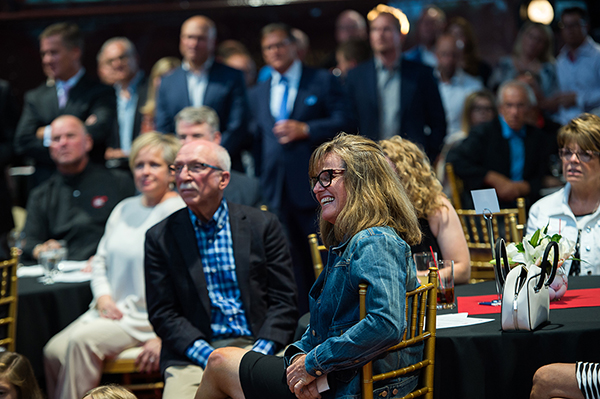
Lorie Kane and family

Lorie Kane and Hunter Harrison

Marilyn O’Connor, Marlene Streit, Lorie Kane and Sandra Post
The history of Olympic golf

Golf’s return to the Olympics this summer will be the first time the sport has been in the Olympics since 1904, a fact probably known by even the sport’s most casual fans.
The story of golf in the Olympics, however, runs much deeper than that and is riddled with ‘what ifs’.
The 1900 Olympics in France, the second Olympiad of the modern era, included both men’s and women’s golf.
The Games were loosely organized and promoted, albeit with no opening or closing ceremonies, and were held as part of that year’s world’s fair in Paris. Few of the winning athletes received medals with most, instead, getting trophies.
Charles Sands of the U.S. was the men’s golf champion beating Walter Rutherford of Great Britain. Margaret Ives Abbott, an art student from Chicago, won the nine-hole women’s competition. She died in 1955 not ever knowing that she was the first female American gold medallist.
The 1904 edition in St. Louis featured Canadian George S. Lyon winning the individual men’s golf competition but no individual female champion. The women’s competition had been dropped and replaced with a men’s team competition, in which Canada did not compete. The United States was the only country entered and so, not surprisingly, won the gold, silver and bronze.
Lyon sailed to London to try to defend his championship in the 1908 games but arrived to find that arguments over who would actually stage the golf competition and oversee rules had resulted in its last-minute cancellation.
The Games organizers offered to give Lyon the gold medal for showing up but he declined it, saying that he hadn’t earned it.
The 1912 Games were in Stockholm, Sweden but golf was in its infancy in that Nordic country and the sport was not included.
Although there was talk over the years about its return, including the Atlanta Olympics in 1996 and the 2008 Games in Beijing, there was no real groundswell for golf until Ty Votaw and Peter Dawson representing the International Golf Federation — along with Padraig Harrington, Michelle Wie, Suzann Pettersen and Matteo Manassero — accompanied Lyon’s Olympic trophy from 1904 into a meeting with the International Olympic Committee in 2009 and convinced them it was time.
 |
The history of Olympic golf This article was originally published in the May 2016 edition of Golf Canada Magazine. To view the full magazine, click the image to the left. |
Road to Rio Olympic exhibit unveiled at World Golf Hall of Fame & Museum

St. Augustine, FLORIDA – With the growing excitement for golf’s return to the Olympics this summer, the World Golf Hall of Fame & Museum opened its “Road to Rio” Olympic exhibition. Amy Alcott, World Golf Hall of Fame Member and architectural design consultant on the Olympic golf course in Rio de Janeiro, Brazil, cut the ceremonial ribbon to signify the opening of the new Hall of Fame exhibition.
“I think we created a special golf course that the city of Rio will be proud of long after we’re gone,” said Amy Alcott. “And as I stand here in the World Golf Hall of Fame’s ‘Road to Rio’ exhibit, I feel much closer to the project. While I wish I would’ve had the opportunity to play in the Olympics for my country, being here is really the next best thing.”
Located upstairs adjacent to the Nancy Lopez exhibit, the “Road to Rio” exhibition takes guests on a historical journey through Olympic golf, beginning in 1900 when golf was first played in the Olympics, to the 1904 Games in St. Louis – the last time golf was included in the Olympic schedule. Fast-forward to 112 years later, golf will make its highly anticipated return to the Olympics in Rio de Janeiro, Brazil this August.
The featured artifacts in the “Road to Rio” exhibition are two rare gold and silver medals won by H. Chandler Egan at the 1904 Summer Games. Egan’s medals represent his achievements in the individual and team competitions. Egan, a Chicago native and a member of the Exmoor Country Club, was captain of the Western Golf Association team that won the gold medal at Glen Echo Country Club in St. Louis. Additionally, he won the individual silver medal, finishing runner-up to Canadian George Lyon. The Olympic Golf Trophy won by Lyon is on display at the Canadian Golf Hall of Fame and has toured to several events this year, including the PGA Show in Orlando, as well as a handful of PGA and LPGA Tour events.
In addition to seeing the Olympic medals, fans visiting the exhibit can learn more about the Olympic qualifiers, the Olympic uniform changes from 1900 to 2016, and even take a photo atop the Olympic podium holding their country’s flag.
The Olympic men’s competition in Rio is scheduled for August 11-14, with the women’s competition scheduled for August 17-20, both at 72 holes of stroke play.
The 1904 Olympic trophy

The Olympic trophy is in the midst of a historic and timely renaissance. Golf’s return to the Games this summer has ramped up interest in the beautiful sterling silver chalice to an unprecedented, never-before-seen level. For decades it remained cloaked in relative obscurity. No more.
Golf Channel showcased the trophy earlier this year in a segment on Morning Drive. It has made public appearances in support of Olympic golf, including at this year’s PGA Merchandise Show in Orlando, Fla., and last year’s WGC-Bridgestone Invitational and RBC Canadian Open. Highlighting a busy upcoming schedule it will tentatively be on display during the Open Championship at Royal Troon, be flown back from Scotland for the RBC Canadian Open the following week, then tentatively be in Rio de Janeiro August 5-21 for the men’s and women’s Olympic golf competitions.
Awarded to Toronto’s George S. Lyon in 1904, the Olympic trophy has never shined quite as brilliantly as it has of late. On permanent display at the Canadian Golf Hall of Fame & Museum on the grounds of Glen Abbey in Oakville, Ont., this uptick in attention has put it into the conversation among the game’s grandest trophies.
“During many Canadian Opens that I played at Glen Abbey, I had a chance to see the Olympic individual trophy George Lyon won several times,” said two-time Masters champion and noted golf historian, Ben Crenshaw. “Mr. Lyon was one of the great amateur golfers in Canadian history. I’ve also read he was a very fine player, with his crowning achievement being his Olympic win in that playoff with Chandler Egan in St. Louis in 1904. It’s a shame he didn’t get the chance to defend the trophy with golf cancelled out of the Olympics in 1908.”
Lyon’s fellow countrymen will take up that quest on his behalf. More than a century later Canada’s Olympic golf team heads to Brazil as the defending gold medallists. The trophy is a symbolic reminder of that victory, a feat that ranks right alongside Mike Weir’s victory at the 2003 Masters as one of this country’s greatest golfing achievements.
“There’s kind of an aura about the trophy,” says PGA Tour winner Nick Taylor, one of the players vying for a spot on the Olympic men’s team. “When you’re around it you feel it. It’s pretty special.”
Lorne Rubenstein can relate to Taylor’s viewpoint. The renowned national writer’s first job in golf was as curator of the Canadian Golf Hall of Fame, Museum & Library during its time in a spacious room on the ground floor of the old Jesuit retreat at Glen Abbey. Now a Hall of Fame member himself, Rubenstein fondly recalls the hours he spent in such close proximity to the iconic piece of golf history.
“The Olympic trophy took pride of place on a stand all its own, in a central part of the museum,” recalls Rubenstein. “I was in the museum every day, and, every day, I would make my way over to this ornate, grand trophy that seemed to stand sentinel over the room, bathed in light pouring in through the leaded windows. It seemed almost mystical to me. The trophy belonged to Canada, to all golfers. I often wondered if we would again see golf in the Olympics, and if golfers from around the world might even again compete for this iconic trophy — so special among all the trophies in the game.”
Made of 26-point sterling silver, the trophy — along with all trophies and medals awarded for golf at the 1904 Games in St. Louis — was commissioned by host course Glen Echo Country Club. Local business J. Bolland Jeweller Co. designed and manufactured the trophy, which features the stately Glen Echo clubhouse on one side.
Fred Lyon, George S. Lyon’s son, donated the trophy along with the clubs his father used in the Olympic Games during his time as a Royal Canadian Golf Association (now Golf Canada) governor back in the late 1950s.
“The RCGA had started to collect memorabilia and artefacts for a potential museum and library in the 1950s,” explains Meggan Gardner, current Canadian Golf Hall of Fame curator. “It was a generous donation of a treasured Lyon family heirloom. It’s certainly our crown jewel.”
And as Rubenstein points out, Canadian golf’s crown jewel is about to go global.
“There was nothing like it. There still is nothing like it,” he says. “In my mind’s eye I still see the trophy in the museum, drawing me in, drawing in all visitors just as it will draw the world’s attention this summer for the Olympics in Rio de Janeiro.”
|
|
Olympic trophy This article was originally published in the May 2016 edition of Golf Canada Magazine. To view the full magazine, click the image to the left. |
George S. Lyon: a man of many talents

Though he should be considered one of Canada’s greatest sporting heroes, the sad reality is that George Seymour Lyon is little known in this country.
That will change, to a small degree, during the upcoming Olympics in Rio de Janeiro when Lyon is recognized as the defending champion in golf for his win in 1904, the last time the sport was in the Summer Games.
What most media won’t have time or the inclination to tell is the full story of who he was, what an amazing athlete he became, how he didn’t take up golf until his late 30s, and won the Olympic gold medal at the age of 46 against a rising star less than half his age. Not to mention how four years later Lyon became one of the first athletes in Olympic history to decline a gold medal because he felt he hadn’t earned it.
“The story of what George S. Lyon did, at age 46, and all of the other things he accomplished in his life is simply remarkable,” says Scott Simmons, CEO of Golf Canada. “There is no doubt in my mind that if he, as a multi-sport athlete, had accomplished what he did in today’s modern era sport and media landscape instead of the late 1800s and early 1900s, that we would be celebrating one of Canada’s most iconic athletes and arguably one of the most compelling stories in the history of sport.”
Lyon was born in Richmond, Ont., near Ottawa, in 1858 and it seems he was born to do historic things. His great uncle Robert Lyon fought and lost the last duel in Canadian history. And his grandfather, captain George Lyon, was wounded but survived in the Battle of Chippewa during the War of 1812. It was a noteworthy battle because it marked the first time that American regulars had defeated British regulars on the battlefield.
The Lyon family moved from Richmond to Toronto where young George would demonstrate a remarkable ability as an athlete. It didn’t seem to matter what sport he tried — track and field, baseball, cricket, hockey, tennis, curling, golf — he was good at it.
At the age of 18 he set a Canadian pole vault record.

George S. Lyon (middle, seated) was a member of the 1894 Canadian International Eleven (Golf Canada Archives)
Lyon was one of, if not the best, batsmen in Canada at a time when cricket was still big in this country.
In 1894, playing for a Toronto team against Peterborough, he carried his bat for 238, a record which lasted for 40 years. And he regularly captained Canadian teams in international competitions.
Lyon was a good enough curler to be a part of numerous championship teams, including vice-skipping a rink that won the Ontario tankard.
Golf was a sport that came late to Lyon, however. He was usually tied up with cricket during the summer months and he even showed some disdain for the game initially.
He was 38 and, if the old story is to be believed, was waiting for a cricket practice to begin when a friend, John Dick, invited him to come to the adjacent golf course to give it a try.
After those first few swings, Lyon like so many before and after him, was hooked on golf.
He eschewed the golf swing of the day and instead came at the ball hard like he was swinging a cricket bat at it. The swing may have been unorthodox and looked odd but the result was prodigious length. That, and his natural athletic ability, allowed him to pick up the sport very quickly. So quickly in fact that within two years he had won the first of his record eight Canadian Amateur Championships.
In September of 1904, Lyon journeyed by train to St. Louis to play in the Olympic Games with two other golfers from his home club, Lambton Golf and Country, which he had helped found and design in then-suburban Toronto.
Lyon, at age 46, qualified for match play and made it to the finals where he faced Chandler Egan, the 20-year-old rising star of American golf who had already won the Western Amateur and U.S. Amateur earlier that summer.
In the 36-hole, one-day final, played partly in a pouring rain storm, Lyon won 3 & 2 to capture the Olympic gold medal (which has long since gone missing) and the majestic championship trophy which resides in the Canadian Golf Hall of Fame & Museum.
Egan, citing exhaustion, retired to his hotel room while Lyon, who had been kidded by the local press about being old and overweight, walked the length of the banquet hall on his hands to accept his reward.
Four years later Lyon went to London, England to attempt to defend his Olympic title. When he arrived, Games organizers informed him golf had been cancelled over a dispute involving the rules of amateur status. They offered Lyon the gold medal but he declined it because he said he hadn’t earned it.
Lyon went on to have many more years of competitive golf and served as an administrator with the Royal Canadian Golf Association (now Golf Canada) including a term as president of the organization in 1923.
He died in 1938 at the age of 79.
|
|
George S. Lyon This article was originally published in the May 2016 edition of Golf Canada Magazine. To view the full magazine, click the image to the left. |