


The many reasons to keep a golf handicap

Did you enjoy watching our Canadian men compete at The Open in England? Will you watch Brooke Henderson , Alena Sharp, Corey Conners and Mackenzie Hughes at the Tokyo Olympics? Do you look forward to the post-pandemic return of the RBC Canadian Open and CP Women’s Open?
When you do, does Golf Canada ever cross your mind? It should. Because Golf Canada is the association that promotes and supports the game of golf in this country. Most of our best players, pro and amateur, might not be where they are today without programs instituted by Golf Canada, like Future Links, Team Canada, and more. The affiliated Golf Canada Foundation raises and grants funds for the advancement of the game including scholarships. Do you (more or less) play by the Rules of Golf?
So it bugs me when the topic of Golf Canada is raised, usually during a post-round gathering, and someone inevitably utters that hoary old line about a Golf Canada membership being akin to paying taxes. (In the interest of full disclosure, I once worked for Golf Canada, then known as the Royal Canadian Golf Association. So while I may be empathetic about their mission, I also have more than a working knowledge of the association’s mandate and programs.)
The “taxes” line is usually followed by something like this: “I don’t need to be a member. I don’t need a handicap.”
Well, yes, you do, if you are remotely serious about your game. Even if you don’t intend to play in a pro-am or a provincial or national event, who in their right mind wants to play a competitive round for even the smallest of stakes with someone who says on the first tee, “I usually shoot about xx”? And then goes out and shoots xx minus 10.
In addition, there is no better way to track your improvement (or lack thereof) than by maintaining an accurate handicap. Posting your scores and stats hole-by-hole helps you understand where the flaws are in your game.

OK, so now that you understand why you need a handicap index, why else would you want to be a Golf Canada member? Here are a couple of more reasons.
- Incident protection: Up to $2,500 reimbursement for damaged, lost or stolen equipment; up to $1,000 towards the cost of repairing or replacing a window; up to $2,500 for golf cart-related accidents; up to $1,000 for travel-related accidents.
- Plus significant discounts on goods and services: 15 per cent off tickets to the RBC Canadian Open and CP Women’s Open; up to 25 per cent off Avis car rentals; 10 per cent off Hilton Hotel room bookings with complimentary upgrades at participating properties; 10 per cent off Golf Canada merchandise; golf benefits with RBC Insurance for home and auto.
All this for $49.95? Less than the cost of a dozen name-brand golf balls!
“It’s a no-brainer,” says an admittedly biased Ryan Logan. “If people knew about all the buckets the membership dollars go into … but the challenge is to get that message out there.”
Logan is Golf Canada’s Director of Membership and he is justifiably pumped about the benefits included in a Golf Canada membership. He is equally enthused about the impressive trend in scores being posted this year.
Logan acknowledges golf participation boomed during the pandemic and sees a commensurate increase in record-setting score posting in 2021. The data backs him up. In March, approximately 160,000 scores were posted nationwide, an increase of 64 percent over 2020. In April, when the weather improved and COVID-related lockdowns relented in some regions, there were about 500,000 posted, an astounding increase of more than 800 per cent. May saw 1.2 million scores posted, a bump of 53 per cent, and June postings were up 15 per cent year over year to 1.7 million.
The pandemic impacted the way scores were posted as well. With the club kiosks removed because of the fear of spreading the virus through contact points, many golfers availed themselves of the new Golf Canada app.
The app is free to use. (Although if you want an official handicap index, you must be a Golf Canada member.) But anyone can use it to track their scores, find courses, play various on-course games (stroke or match play, skins), use the on-course GPS function to determine distances to a selected target, and more.
Take it from me. The app is intuitive and easy to use. I’ve started posting my scores hole by hole and so have many others, says Logan. The new World Handicap System encourages golfers to do so and Canadians have responded. According to Logan, about 20 per cent of scores were hole by hole pre-WHS. That doubled in 2020 and he estimates that up to 70 per cent of all scores will be itemized in that manner this year.
Having said all this, some of you still won’t be persuaded to shell out $49.95. So be it.
Golf, Canada!
Click here to become a Golf Canada member.
What golfers ought to know about the World Handicap System

Like many of you, I’ve always been diligent about maintaining an accurate handicap. The reasons are ridiculously obvious: I want to know if my game is improving (or not) and I want to ensure that when I compete in net events, I’m being honest and equitable with my fellow competitors.
I never really thought about the mechanics of the system, perhaps because I was too lazy or disinterested to read through the ponderous Handicap Manual (now called the Rules of Handicapping). I gave full credit to the boffins who came up with the convoluted doorstop but never cared to interview the geniuses behind the curtain.
And then, this year, along came the World Handicap System.
Perhaps because of the restrictions due to COVID-19, golfers had more time on their hands. In any case, I’ve never been asked more handicap-related questions at the course or on social media. So, taking a cue from the manuals that accompany your new car or fridge or TV, here’s my version of a “Quick Start Guide” for the World Handicap System.
Why a new handicap system?
Why not? Golf now has both a globally recognized set of Rules as well as a worldwide handicap system. Even if you never travel outside Canada, you can be assured you are playing the same game as every other golfer around the world. The new system may require some tweaking after it’s been in effect for a while but it’s doubtful there will be another significant revision in the near future.

How does the new World Handicap System work?
At one of the meetings of the 23-member committee tasked with creating the new system, a USGA delegate compared understanding the intricacies of the handicapping system with air travel.
“I have no idea how an airplane works. I don’t understand jet propulsion, aeronautics and so on, but I trust that when I get on that plane, it will get me safely to the destination I intended.”*
Likewise, the process of coming up with the World Handicap System would make your head spin, so just concern yourself with the final outcome.
But if you’re in quarantine or a masochist or one of those aforementioned boffins, you can review the Rules of Handicapping here.
Has the Course Handicap calculation changed?
Yes. To your benefit. Under the old system, there might have been just a two- or three-shot difference in your Course Handicap from the front to back set of tees, despite the fact that those tee decks might be separated by 1,500 yards.
Under the new system, that difference now might be 10 to 12 shots because the par of the course has been integrated into the calculation.
Why doesn’t my Handicap Index go up when I post a high score?
Under the old system, the low 10 of your most recent 20 scores were used to calculate your Handicap Index. Under the new system, the low eight are used. So that bad score may not enter into the calculation. Similarly, using the most recent eight scores instead of 10 may have lowered your Index.
What the heck is Net Double Bogey?
“Net Double Bogey” has replaced the old Equitable Stroke Control system (ESC).
Now everyone’s maximum score for handicap purposes is net double bogey. Simply put, this is the par of the hole PLUS two strokes (double bogey) PLUS any handicap strokes you may be allowed on that hole.
If you don’t want to have to figure that out when you’re posting your score, let the Golf Canada Score Center do it for you. When you enter your score hole by hole, the Score Center automatically adjusts for net double bogey.
And for those of you complaining about posting scores hole by hole: You play the game hole by hole so why not post your score that way? It takes only a couple of minutes and provides some interesting data.
Here’s my Super Easy Quick Start Guide:
Post all your scores hole by hole immediately after your round. Let the Golf Canada Score Centre take care of the rest. And check out the new app which makes the process even easier.
(*Thanks to Craig Loughry, Director of Golf Services at Golf Ontario, for this anecdote and other invaluable assistance with this article. Loughry was the Canadian representative on the World Handicap Operations Committee.)
Rules of Golf & Rules of Handicapping COVID-19 Guidelines

CLICK HERE FOR COVID-19 RULES OF GOLF AND RULES OF HANDICAPPING GUIDANCE
* Updated July 13, 2020
The COVID-19 global pandemic is a difficult time for Canadians and Golf Canada stands with our entire golf community during this unprecedented time.
We all love the game for the escape it provides and its positive impact on our physical, social and mental well-being.
We continue to urge golfers to follow the guidelines from health and governmental officials to keep you and those around you safe, and to minimize any possible exposure to coronavirus. This is especially true on a golf course, where golfers, workers and operators should heighten their level of awareness on exposure to surfaces like flagsticks, golf balls, bunker rakes, tees, carts and scorecards. We all need to do our part to respect expert advice and make the right decisions to protect each other.
It is not the intended purpose of the below guidance to either encourage or discourage anyone from playing the game, but rather, in our governance role, to help golf course operators, committees and golfers better understand how the Rules of Golf and Rules of Handicapping apply to the various questions received by the governing bodies.
The Modernized Rules of Golf were drafted to offer each Committee the flexibility to make decisions as to how golf is played at their course or in competition and the Committee Procedures section of the Official Guide to the Rules of Golf (available online here) offers a significant amount of guidance and recommendations on how to address circumstances unique to each course or competition.
This flexibility will prove to be very helpful as Committees look to address many of the challenges they are facing within the current environment. While the Committee Procedures section is a tremendous resource and has much to offer, many of the current questions were not originally contemplated under the Rules of Golf and therefore there is no history or guidance provided. To better address the questions that have come about because of these unique circumstances and the related challenges, additional guidance can be accessed by clicking here. This will continue to be updated as additional questions are received.
As active seasons start to open across the country, we would like to discuss impacts on Handicapping. From the perspective of the Rules of Handicapping, the most frequent questions received are primarily related to the acceptability of scores for posting to a player’s scoring record. In particular, to modifying the hole and not requiring the player to “hole out” as required under the Rules of Golf. These are founded in a desire to minimize the possibility of exposing golfers to coronavirus and have included leaving the hole liner raised above the putting surface or placing various objects into the hole so the ball can be more easily removed. In these specific cases, ensuring guidance from health and governmental officials is being followed, a temporary measure is in place in Canada to accept scores played under these conditions for handicap purposes using the most likely score guidelines (Rule 3.3, Rules of Handicapping), even though the player has not holed out.
Please remember that this temporary measure is now in effect within Canada until advised otherwise by Golf Canada.
For more information and detailed guidance, please contact your Provincial Golf Association or Golf Canada.
Your golf handicap is changing – find out why it matters

Welcome to Golf Handicaps for Dummies: Why having a handicap is not a handicap.
No, I’m not calling you a dummy, but if you’re a golfer of any ability who doesn’t maintain an accurate and consistent handicap, you’re not taking advantage of one of the fundamentals that makes golf the most democratic of sports. And that’s just dumb.
With all due respect, you can’t go one-on-one with a pro basketball player or hope to score on an NHL goalie. They’re not going to let you shoot at a basket that’s lower than regulation or a net that’s 10 feet wide and six feet high.
But golf’s handicap system allows you to compete on an equitable basis with players who are more or less accomplished than you are. Maintaining a handicap also allows you to monitor your progress every time you play. It’s an integral part of your golf experience.
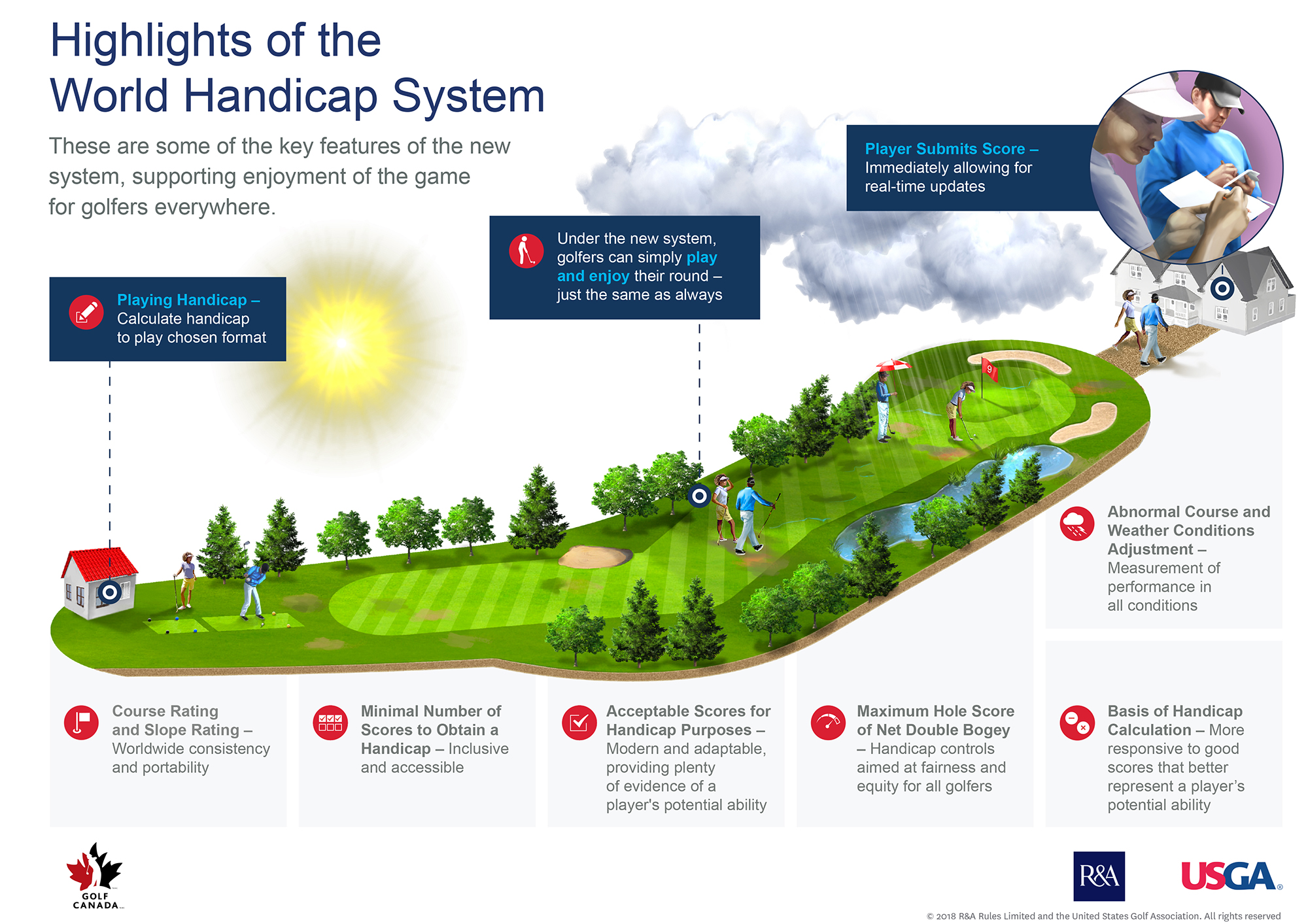
And, starting Jan. 8, the new World Handicap System makes that scenario even more attractive. More user-friendly, in other words.
“The new system gives golfers an increased opportunity to have fun and compete equitably across all skill levels and ages,” says Shaun Hall, Golf Canada’s senior manager of handicap & course rating.
“You don’t have to be a competitive golfer. If you simply enjoy playing, having a handicap makes the game more enjoyable and allows you to track whether you’re improving.”
I reached out on Twitter with the question, “Do you maintain a handicap and why?” and received some testimonials.
Ontario golfer Donal Byrne says, “I’m a huge fan of keeping a handicap. I was thrilled to have closed the season inside of 20 [Handicap Index] for the first time. We should celebrate everyone who plays, no matter how they play. I just won’t play anyone who doesn’t have a handicap for money!”
And from Charlottetown, Jeff Craig, whose Twitter profile says he’s “dedicated in my quest to break par,” says, “It bugs the Hell out of me when someone [without a handicap] says, ‘Well, I usually shoot in the mid-80s and wants to play for something.’”
On a personal note, my wife loves the game and posts every score. Her pride in seeing her handicap decrease is evident. Because she is diligent about maintaining her handicap and improving her skills, she was able to win the ladies’ net championship at her club. As a side note, she plays annually in a member-guest at another club where you must have an official Golf Canada Handicap Index to participate.
When she first took up golf, she had waffled about establishing a handicap because, in her words, “I don’t think I’m good enough to have a handicap.”

And that’s the most common excuse recreational golfers give for not caring about a handicap. “I’m not good enough.” Hall disputes that, especially given the fact that under the new system the maximum Handicap Index (which replaces the previous “Handicap Factor” in Canada) has been raised to 54.0 for both men and women. Previously, it was 36.4 for men and 40.4 for women.
Another significant change is to Equitable Stroke Control (ESC). Starting in 2020, net double bogey on any hole is the maximum allowed, whether it’s a par 3, par 4 or par 5. So, for handicap purposes, you can count a maximum of two strokes over par plus any strokes you are entitled to, based on the stroke allowance for that hole.
Obviously, from its name, the World Handicap System is now accepted globally, meaning the same parameters are in place no matter where you play, a boon for Canadians who travel and golf outside the country. As before, all scores can be conveniently posted on the Golf Canada Score Centre, club kiosk or Golf Canada app from your phone or tablet.
3 more significant innovations
- Only three 18-hole scores (or the equivalent combination of nine-hole scores) are needed to establish a Handicap Index. Previously, the minimum was five. What golfer doesn’t play more than 54 holes in a season?
- Only eight of your lowest 20 most recent scores will be used to calculate your Handicap Index, rather than the previous 10.
- And a Playing Conditions Calculation will analyze how you played that day compared to your expected performance on that particular course, taking into account weather and course setup.
Don’t ask me how that last one works, because I’m a tech dummy.
Click here to purchase the official Rules of Handicapping book.
But even if you don’t, don’t be a dummy. Take advantage of the new World Handicap System in 2020.
Not a member? Join now and take advantage of the new handicapping software and other exclusive benefits!
Course rating allows handicaps to be portable to any golf course
Slope rating is the difference between the course rating for a ‘scratch’ golfer and the course rating for a ‘bogey’ golfer multiplied by a factor. The Slope rating indicates the difficulty of a golf course for the ‘bogey’ golfer relative to the scratch player.
Click here for more information on the World Handicap System.
Acceptable golf scores can be submitted in various formats to reflect an accurate handicap
The World Handicap System is designed to offer golfers plenty of opportunities to submit scores for handicap purposes. The more acceptable scores a player submits, the more accurate their handicap index will be.
Click here for more information.
Golf’s World Handicap System raises maximum handicap index to 54
The maximum Handicap Index has changed. Where previously there were different values for men and women, now there is one maximum Handicap Index regardless of gender. The maximum Handicap Index is 54.0.
Click here to learn more.
How your handicap is calculated under golf’s new World Handicap System
The World Handicap System will ensure handicaps are calculated consistently around the world.
Click here for more information.